
Abstract
This research was done on patients who were suffering from tolerable painful lesions in the oral cavity. These lesions were oral ulcers with soft consistency and the size of the oral ulcers varied from 2 mm to 8 mm respectively. They were treated using L-ornithine-L-aspartate & Silymarin suspension/ syrup and tablet Ursdeoxycholic acid 300 mg.Introduction - All about oral ulcers
Oral ulcers are painful lesions in the oral cavity. They vary in size and their symptoms depend on the type of ulcer. Etiology: The exact cause is still not known and the etiology varies from person to person. However, there are some common causes and aggravating factors such as:- Biting the tongue or inside of cheek( buccal mucosa).
- Braces, poor fitting dentures and other appliances that may rub against the mouth and gums (gingiva).
- A deficient restoration/ filling.
- Stress or anxiety.
- Hormonal changes during pregnancy, puberty & menopause.
- Medications including beta blockers and painkillers.
- Genetic factors.
- Conditions such as Celiac or Crohn's Disease, Vitamin B 12 or Iron deficiency, or a weakened immune system that may trigger oral ulcers to form.
- Minor Ulcers: This type can range in size of about 2mm upto about 8 mm. These ulcers typically take upto 2 weeks to get better and will cause some pain.
- Major Ulcers: Bigger than minor ulcers, major oral ulcers are often irregular in shape, maybe raised and penetrated deeper into the tissue than minor oral ulcers.They can take several weeks to go away and are likely to leave scar tissue when they clear.
- Herpetiform Ulceration (HU): Herpetiform oral ulcers get their name because they resemble sores associated with Herpes. Unlike Herpes, Herpetiform Ulceration (HU) is not contagious. HU recur very quickly and it may appear that the condition never gets better.
- One or more painful sore that may appear in buccal mucosa, the roof of the mouth, the labial mucosa, or the tongue.
- The appearance of round lesions that have red edges are yellow, white or gray in middle.
- HU lesions may appear as extremely painful oral ulcers in the mouth.
- Recur very quickly .
- May increase in size , eventually coming together to form a large ragged ulcer.
- Appear anywhere in mouth.
Case report
This clinical research was done on 7 male patients, aged between 25 to 35 years of age. These patients visited the author’s private dental practice, with the complaint of painful, but tolerable oral lesions. They did not have any medical comorbodities or any history of tobacco chewing, smoking or intake of tobacco in any other forms.Their dental history was non significant -they did not have any carious tooth, broken restorations or use of any dental prosthesis. On clinical examination, these lesions were found to be present on buccal mucosa & gingiva. The consistency was soft and the size ranged from 2mm to 8 mm. It was diagnosed that the patients were suffering from minor oral ulcers. Informed consent was taken from the 7 patients who became the part of this research.All these 7 male patients were prescribed:- L-ornithine-L-aspartate, Silymarin suspension/ syrup - one and half tablespoon once a day, daily after food, for 10 days and
- Tablet Ursdeoxycholic acid 300 mg once a day ,daily after food ,for 10 days
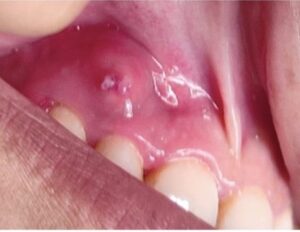
Before
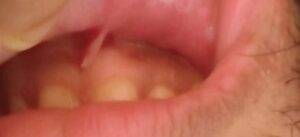
After
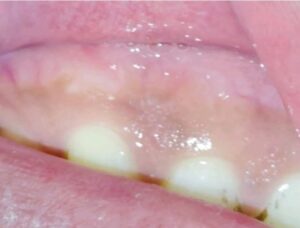
Before
After
Discussion
A total of 7 patients were taken into account for this research.Their oral ulcers were healed after taking the prescribed drugs; namely L-ornithine-L-aspartate, Silymarin And Ursdeoxycholic acid.- L-ORNITHINE-L-ASPARTATE: L-ornithine-L-aspartate infusion injections are used to treat skin problems like skin ulcers. It is a chemical that is broken down by the body to increase the levels of two amino acids, namely ornithine & aspartic acid. Ornithine and aspartic acid helps to reduce levels of the toxic chemical 'ammonia ' in the blood.
People use it for reduced brain functions due to advanced liver disease (hepatic encephalopathy). It is also used for athletic performance but there is no good scientific evidence to support this use. Preautions and warings before using l-ornithine-l-aspartate:
- L-ornithine-L-aspartate is possibly safe when used in doses upto 18 grams daily for upto 6 months. It is generally well tolerated.
- Pregnancy and lactation: There isn't enough reliable information to know if L-ornithine-L-aspartate is safe to be used during pregnancy or lactation.
- SILYMARIN: For many years, Silymarin has been used as a 'hepatoprotectant’. Although the mechanism of action is not completely known, Silymarin has been reported to have anti oxidant, immuno-modulatory, anti fibrotic, anti inflammatory, anti proliferative and anti viral properties. Silymarin has a short half life and quick conjugation in liver with the principal excretion in bile.
- URSDEOXCYHOLIC ACID: Ursdeoxycholic Acid is a bile acid component with anti apoptotic ,anti oxidant and anti inflammatory properties. Ursdeoxycholic Acid is used to dissolve gall stones in various liver related disorders such as cirrhosis, sclerosing cholangitis and liver dysfunction. This medicine acts a dissolving agent, which reduces cholesterol content in bile.
- Ursdeoxycholic Acid is contraindicated in intestinal ulcers or bleeding.
- If the patient has a recent surgery involving any part of intestine.
- If the patient is suffering from inflammation/blockage of gall bladder.
- Alanine Transaminase(ALT)
- Aspartate Transaminase (AST)
- Alkaline Phosphatase (ALP)
- Gamma Glutamyl Transferrase (GGT)
- Serum Bilirubin,Prothrombin Time(PT)
- International normalised ratio (INR)
- Total Protein & albumin.
Conclusion
From the above mentioned clinical research it can be concluded that to treat oral ulcers (soft consistency) of size from 2mm to 8mm, drugs such as L-ornithine-L-aspartate, Silymarin & Ursdeoxycholic acid can be prescribed, without prescribing any antibiotics, NSAIDS, Analgesics, mouthwash, or topical gels like chlorhexidine gluconate and triamcinolone.Limitations
Limitation of this clinical research are as follows:- Sample size - The sample size was very limited.
- Lack of literature - There is not enough medical literature present which strongly gives the evidence that these medications can cure oral ulcers of soft consistency which ranges in size from 2mm to 8mm.
- Cost effectiveness - The prescribed medications are not cost effective, as compared to the other typical treatments.
- Gender and age bias - There is not enough scientific evidence which suggests that these medications can treat oral ulcers of people of both genders or of much different age groups than the one taken into account in this research.
Special note - Difference between oral cancer & oral ulcers
Some clinicians find it challenging to differentiate between oral cancer and oral ulcer. Both are distinctive in their symptoms. Oral cancer is a type of oral ulcer but not all oral ulcers are oral cancers. Persistent oral ulcers require observation - a non healing ulcer is a cause of concern. There are some fundamental differences between oral ulcers and what might be oral cancer.- Oral ulcers are often painful areas or lesions whereas oral cancer is not.
- Oral ulcers will clear up in about 2 weeks whereas oral cancer will not heal and will often spread (metastasis).
- Oral cancer patches may be rough, hard and not easy to scrape off.
- Oral cancer is often a mix of red and white areas or large white areas,that appear in tongue,the back of the mouth,the gingiva or the buccal mucosa.
- Oral cancer is often linked to heavy drinking or tobacco use.
A persistent, unexplained, indurated or otherwise suspicious ulcer warrants prompt evaluation through an assessment pathway for suspicious oral ulcers.
Explore more with DentalReach
Read the DentalReach dental magazine for professional perspectives, browse clinical dental articles for practical learning, and follow dental news for updates across the profession. You can also read our dental magazine editions.
Continue learning through dental events and conferences, listen to dental podcasts featuring professional conversations, and exchange questions and experiences in our dental forums.
For your next career step, explore dental jobs and opportunities across dental practices and organizations.