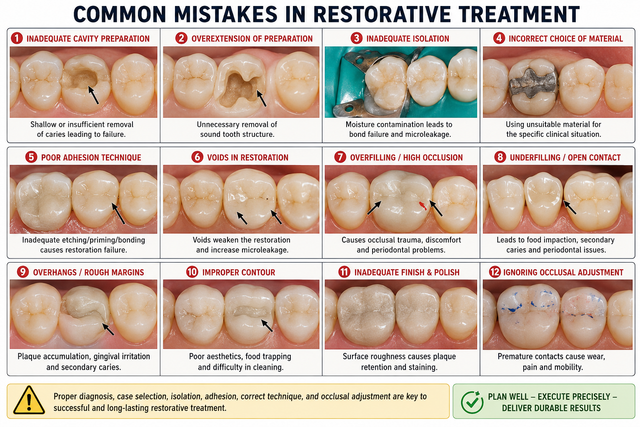
To be fair, even experienced clinicians run into preventable errors, especially when schedules are tight, teams are stretched, or protocols drift over time. The good news is that many clinical “mistakes” are not about skill, but about small process gaps that compound: incomplete isolation, rushed impressions, inconsistent moisture control, missed pre-op checks, or unclear lab and chairside communication.
This June issue focuses on the most common pitfalls across everyday procedures and, more importantly, how to avoid them with simple, repeatable steps. Think of it as a practical checklist for higher predictability, fewer remakes, and better patient outcomes.
Why mistakes happen (even in good clinics)
Clinical dentistry is a high-precision workflow built on many small handoffs: patient to clinician, clinician to assistant, clinic to lab, and back again. Mistakes usually show up when one link is weak.
Common underlying causes include:
Inconsistent protocols between providers or operatories
Missing documentation (photos, bite records, shade notes, implant details)
Rushed isolation and moisture control
Over-reliance on “memory” instead of chairside checklists
Communication gaps with the lab or within the team
Tip: A useful way to reduce errors is to standardize “critical control points” in each procedure: the few steps that, if done well, prevent the majority of failures.
Common mistakes in conventional implant impressions (and how to avoid them)
Conventional implant impressions are still widely used, but they leave little room for error. If the record is unstable or unclear, the lab can’t reliably reproduce implant position or soft-tissue anatomy, which increases the risk of misfit, chairside adjustments, and remakes.
Where clinicians and teams often slip
Mistakes tend to cluster around three areas: component selection, stabilization, and soft-tissue capture.
Using the wrong impression coping type (open vs closed tray) for the clinical situation
Inadequate coping seating verification (no radiographic or visual confirmation)
Coping movement during impression making or tray removal
Poor tray design or insufficient rigidity leading to distortion
Incomplete soft-tissue emergence profile transfer, especially around healing abutments
Practical ways to prevent errors
A more predictable workflow usually comes from tightening verification and communication:
Confirm coping seating before impression (and re-confirm after tightening).
Use rigid trays and controlled material thickness to reduce distortion.
Stabilize components and minimize movement during removal.
Send the lab clear notes on implant system, platform, tissue goals, and photos when possible.
The objective is simple: deliver a clean, readable, stable record so the lab can fabricate with confidence.
Common mistakes in minor periodontal surgeries (and how to avoid them)
Minor perio surgeries can look straightforward, yet small misjudgments can affect healing, patient comfort, and long-term stability. Avoidable issues often arise from case selection, flap handling, and post-op planning.
Typical pitfalls
Underestimating tissue biotype or blood supply considerations
Overextending flap design or compromising tension-free closure
Inadequate debridement or root surface management
Inconsistent suturing technique leading to micro-movement
Incomplete post-op instructions or weak follow-up scheduling
Prevention without overcomplicating your workflow
Small changes can make outcomes more predictable:
Define the surgical goal clearly (access, regeneration, reshaping, coverage) before incision.
Plan for tension-free closure from the start, not as an afterthought.
Standardize post-op instructions and build a default review timeline into scheduling.
When the team knows the “why” behind each step, the workflow becomes simpler, not more complex.
Common mistakes during root canal treatment procedures
Modern endodontics has improved dramatically, but procedural errors still occur in routine practice. These mistakes can compromise canal disinfection, weaken tooth structure, damage periodontal tissues, or prevent complete obturation, all of which can reduce prognosis.
Free for members
Keep reading — it's free
The rest of this article is open to DentalReach members. Create a free account, or sign in, and every article on the site opens in full.