

Introduction
Management of infected primary teeth in pediatric patients presents a unique challenge due to anatomical, behavioral, and physiological considerations. Conventional endodontic procedures such as pulpectomy require mechanical instrumentation, which may be difficult in uncooperative children and in teeth with complex root canal morphology. In this context, Lesion Sterilization and Tissue Repair (LSTR) therapy has emerged as a minimally invasive, biologically based treatment modality.
LSTR is grounded in the principle that elimination of pathogenic microorganisms from the lesion can promote natural healing and tissue regeneration without extensive mechanical debridement. Introduced by the Cariology Research Unit at Niigata University School of Dentistry, Japan, LSTR has gained popularity in pediatric dentistry due to its simplicity, effectiveness, and reduced chairside time.
Concept and Biological Basis of LSTR
The fundamental concept of LSTR revolves around sterilizing infected dentinal, pulpal, and periapical tissues using a combination of antibacterial agents, thereby enabling the host’s natural defense mechanisms to repair damaged tissues. Unlike traditional root canal therapy, which focuses on mechanical removal of infected pulp tissue, LSTR emphasizes chemical disinfection.
The rationale behind this technique lies in the understanding that bacteria is the primary etiological factor in pulpal and periapical diseases. By eliminating bacterial load, inflammation subsides, and healing processes such as bone regeneration and revascularization can occur.
Indications of LSTR in Pediatric Dentistry
LSTR is particularly indicated in cases where conventional endodontic procedures are impractical or contraindicated. These include:
Primary teeth with necrotic pulp
Teeth with periradicular or interradicular radiolucencies
Uncooperative pediatric patients
Teeth with extensive root resorption where instrumentation is difficult
Medically compromised children where shorter treatment duration is preferred
Non-vital primary molars with sinus tract formation
Contraindications
Despite its advantages, LSTR is not universally applicable. Contraindications include:
Teeth with advanced root resorption nearing exfoliation
Presence of systemic infection requiring systemic antibiotics
Allergy to any of the antibiotic components
Teeth with non-restorable crowns
Cases where adequate isolation cannot be achieved
Composition of Triple Antibiotic Paste (TAP)
The cornerstone of LSTR therapy is the use of Triple Antibiotic Paste (TAP), typically consisting of
Metronidazole – effective against obligate anaerobes.
Ciprofloxacin – broad-spectrum antibiotic targeting gram-negative bacteria,
Minocycline – effective against gram-positive and gram-negative organisms.
These antibiotics are mixed in equal proportions and combined with a suitable vehicle such as propylene glycol or macrogol to form a paste that can be easily delivered into the cavity.
Mechanism of Action-
Mechanism of LSTR
The success of LSTR lies in the synergistic antibacterial effect of the antibiotic combination. Metronidazole targets anaerobic bacteria, which are predominant in necrotic pulps, while ciprofloxacin and minocycline broaden the antimicrobial spectrum.Once bacterial elimination is achieved, the inflammatory process subsides, allowing host immune responses to initiate tissue repair, including regeneration of periapical bone and resolution of radiolucency. In some cases, evidence of revascularization and continued root development has been reported.
Preparation of TAP
To prepare the paste, commercially available antibiotics are placed in separate dappen dishes. The enteric coating of tablets is removed by scraping with a blade, while the outer capsular material is taken off capsules. Each component is then ground separately using a clean mortar and pestle, ensuring that the powder remains dry. If the powder needs to be stored at this stage, it should be placed in tightly sealed porcelain containers, kept in a dark place or a refrigerator to avoid exposure to light and moisture.
After proper pulverization, the powdered components are combined on a clean glass slab or mixing pad. A part of the solvent is then added. For optimal effectiveness, the triple antibiotic mixture is typically prepared with a ratio of seven parts of the powdered antibiotics to one part of the solvent.
Clinical Procedure of LSTR
The LSTR technique is relatively simple and can often be completed in a single visit:
Diagnosis and Case Selection: Proper clinical and radiographic examination is essential to confirm pulpal necrosis and periapical pathology.
Isolation: Rubber dam isolation is preferred to prevent contamination.
Access Cavity Preparation: Minimal access is made without extensive instrumentation of canals.
Removal of Necrotic Debris: Superficial caries and necrotic tissue are removed, but deep instrumentation is avoided.
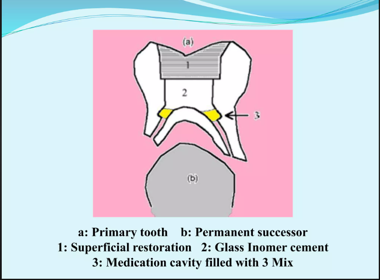
Placement of Triple Antibiotic Paste-The prepared TAP is placed into the pulp chamber and canal orifices.
Sealing of the Cavity-The cavity is sealed using a suitable restorative material such as glass ionomer cement.
Follow-Up- Clinical and radiographic evaluation is done periodically to assess healing.
Advantages of LSTR
LSTR offers several clinical benefits, especially in pediatric practice:
Minimally invasive procedure
Reduced chairside time
No need for complex instrumentation
Suitable for uncooperative children
High patient and parent acceptance
Effective in infected primary teeth with complex anatomy
Promotes natural healing
Clinical Outcomes and Success Rate
Several clinical studies have demonstrated favorable outcomes with LSTR, reporting high clinical success rates ranging from 70% to 90% in primary teeth. Clinical success is defined by absence of pain, swelling, and sinus tract, while radiographic success includes reduction or disappearance of radiolucency.
Conclusion
Lesion Sterilization and Tissue Repair (LSTR) represents a paradigm shift in pediatric endodontics, emphasizing biological healing over mechanical intervention. It is a valuable treatment option for managing infected primary teeth, particularly in young or uncooperative patients. Although promising, LSTR should be used judiciously, considering its limitations and the need for further long-term clinical evidence. With ongoing research and refinement, LSTR has the potential to become an integral part of minimally invasive pediatric dental care.
LSTR requires careful indication and antimicrobial stewardship
LSTR aims to disinfect infected primary-tooth lesions with limited instrumentation, but protocols, medicaments and outcomes vary. Local antibiotic mixtures are not biologically neutral: allergy, resistance selection, staining, tissue effects and medicament availability must be considered. It should not be used to retain a non-restorable tooth or delay management of spreading infection.
| Assessment | Favourable consideration | Reason to avoid or refer |
|---|---|---|
| Tooth prognosis | Restorable tooth with strategic value | Non-restorable crown or advanced resorption |
| Infection | Localised condition within protocol | Cellulitis, systemic involvement or uncontrolled swelling |
| Follow-up | Reliable clinical and radiographic review | Unable to ensure monitoring |
| Medicaments | Evidence-based authorised protocol | Allergy, unsafe mixture or stewardship concern |
Connect with child-centred behaviour management, MIH severity-based care and paediatric clinical research planning.
Frequently asked questions
Is LSTR a replacement for every pulpectomy?
No. Indication depends on diagnosis, restorability, root status, infection, cooperation and evidence.
Are local antibiotics risk-free?
No. Allergy, resistance, staining and tissue effects require stewardship.
What follow-up is required?
Clinical symptoms, restoration, exfoliation pathway and radiographic healing should be reviewed.
LSTR should be considered only after diagnosis, restorability and antimicrobial stewardship are weighed against alternative pediatric pulp-treatment options.


