Prosthodontics

All About Multiunit Implant Abutments

This guide breaks down what multi-unit abutments are, when they’re used, how they compare to alternatives, and what to watch for clinically and operationally.
Dr. Nupur Shrirao

Dr. Nupur Shrirao

Head & Owner

6 min read65,257 views
Contents

Abstract

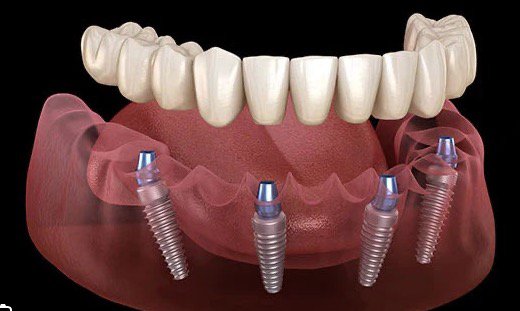
​Multiunit implant abutments are small components with a big job: they connect a dental implant (usually, multiple implants) to a single long-span screw-retained, implant-supported restoration. They’re most commonly associated with full-arch treatments, such as fixed hybrid bridges, where predictability, retrievability, and passive fit matter. If you’re evaluating multiunit abutments for your implant workflow, this guide breaks down what they are, when they’re used, how they compare to alternatives, and what to watch for clinically and operationally.

​(This is a part of theImplant Dentistry - Updated Yet Simplified Seriesby prosthodontist & implantologist Dr Nupur Shrirao)

​Multiunit implant abutments are small attachments, most commonly associated with full-arch treatments, such as fixed hybrid bridges, where predictability, retrievability, and passive fit matter.

If you’re evaluating multiunit abutments for your implant workflow, this guide breaks down what they are, when they’re used, how they compare to alternatives, and what to watch for clinically and operationally.

Type caption (optional)

What a multiunit implant abutment is

A multiunit abutment (often called an MUA) is an intermediate abutment that sits on top of the implant and creates a standardized restorative platform above the soft tissue. All procedures done, be it impression making, temporisation or final prosthesis placement is then done on MUAs. Instead of connecting the prosthesis directly to the implant, the prosthesis connects to the multiunit abutment.

This “abutment-level” approach is especially valuable when implants are angled, placed at varying depths, or need a consistent restorative interface across multiple sites.

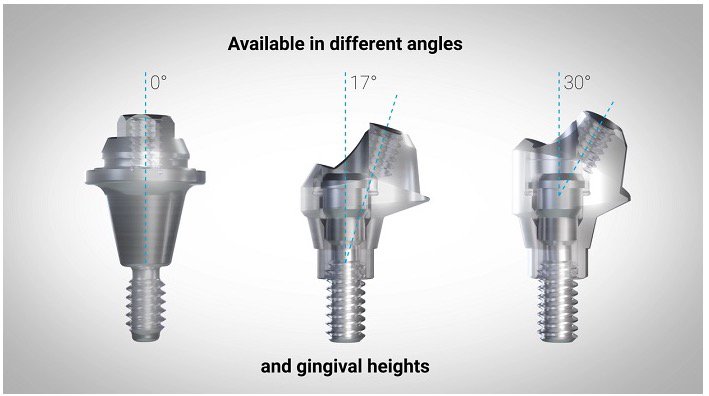
​They are designed to correct divergent implant angles, overcome limited restorative space, and allow for a passive fit, typically offering straight, 17°, or 30° angled options to optimize prosthetic insertion.

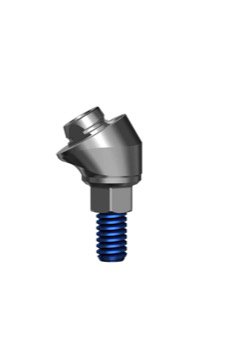
Parts of the multi-unit abutment

​MUAs vary by angulation,collar height,connection type, andplatform. Selecting the right combination helps ensure restorative space, tissue management, and screw access.

Straight vs. Angulated MUAs
Type caption (optional)

  • Straight MUAsare used when implants are already positioned favorably.

  • Angulated MUAshelp redirect screw access when implants are tilted (common in posterior regions or anatomy-driven placement). MUAs typically offer 17° or 30° angled options (sometimes 45°)

Angulated options are often chosen to improve screw channel position and reduce prosthetic compromises without changing implant placement.

​Collar height and tissue considerations
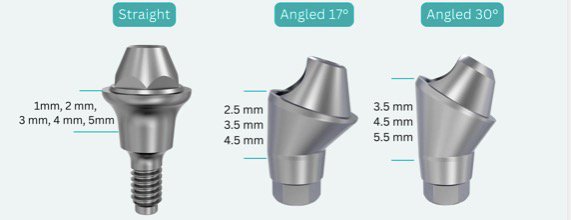
Straight and angulated abutments with usually available gingival collar height

Collar height influences where the restorative interface sits relative to the soft tissue. In broad terms:

  • Shorter collarscan be useful when soft tissue is thin or restorative space is limited.

  • Taller collarsmay help when you want the interface to sit higher above thicker tissue, potentially improving access for cleaning and reducing tissue impingement.

The goal is a stable, cleansable transition that supports the prosthesis design and patient hygiene.

When multiunit abutments are typically used

While MUAs can be used in single-unit situations, they are most common in multi-implant and full-arch cases.

Common indications

  1. Full-arch fixed bridges (All-on-X style restorations)

  2. Multiple implants with non-parallel trajectories

  3. Cases needing a standardized restorative interface(e.g., same driver, same screw type, consistent restorative height)

  4. Situations where prosthesis retrievability is a priority(maintenance, repairs, hygiene access)

​What it does in simple terms

  • Corrects angulationso the restorative screws can emerge in a workable position

  • Creates a common platformacross multiple implants

  • Moves the restorative connection above the tissue, which can simplify hygiene and maintenance

  • Supports a screw-retained prosthesis with a apssive fitdesigned for retrievability

Clinical Tip: Many clinicians choose MUAs to simplify long-term service. Being able to remove a prosthesis without disturbing the implant connection can reduce chair time and risk during repairs.

Multiunit abutments vs. other restorative approaches

Choosing between implant-level and abutment-level restoration impacts accuracy, serviceability, and long-term workflow.

Approach

Connection level

Typical use

Key advantage

Key trade-off

Multiunit abutments

Abutment-level

Full-arch, multi-implant

Standardized restorative interface

Additional component stack

Direct-to-implant (implant-level)

Implant-level

Single crowns, some bridges

Fewer components

More complexity when implants aren’t parallel

Custom abutments

Abutment-level

Esthetic single units

Emergence profile control

Less standardization across multiple implants

How MUAs support full-arch workflows

Full-arch restorations demand repeatability. Multiunit abutments can make the entire chain—from impression/scan to final delivery—more consistent.

Standardization across implants

With MUAs, the restorative interface becomes consistent even when implants are placed at different angles or depths. That can simplify:

  • Impression copings and scan bodies

  • Lab analog selection

  • Temporary and final prosthesis fabrication

  • Prosthesis seating and verification

Retrievability and long-term maintenance

Because the prosthesis is typically screw-retained to the MUAs, the restoration can be removed for:

  • Hygiene and peri-implant evaluation

  • Repairs (fractured denture tooth, chipped material, screw replacement)

  • Occlusal adjustments or relines in hybrid designs

This “service-first” mindset is one reason MUAs are so common in full-arch cases.

Type caption (optional)

Key clinical planning considerations

Multiunit abutments can be forgiving, but they don’t replace sound planning. These are the areas that most often determine success.

Passive fit and framework accuracy

Full-arch frameworks need a passive, accurate fit to reduce mechanical complications. MUAs can help by creating a consistent restorative platform, but accuracy still depends on:

  • Verification steps (jigs, try-ins, or digital verification workflows)

  • Lab precision

  • Tight control over component compatibility

Restorative space and prosthesis design

You need enough vertical and horizontal space for:

  • Abutment height

  • Prosthetic screws

  • Framework (metal or zirconia)

  • Acrylic/ceramic thickness (depending on design)

Limited space can increase fracture risk and complicate hygiene contours.

Screw mechanics and torque protocols

Most multiunit systems include a recommended torque range for:

  • Seating the MUAs to the implants

  • Seating the prosthetic screws to the MUAs

Following manufacturer torque specifications and using calibrated drivers can reduce screw loosening and component wear over time.

​Clinical Tip: Mixing components across different implant systems can introduce fit discrepancies. Use compatible parts and confirm system-specific specifications before ordering.

Digital dentistry and multiunit abutments

MUAs integrate well with digital workflows because they offer a standardized level for scanning.

Where MUAs fit in a digital chain

  1. Place implants and seat MUAs

  2. Capture intraoral scan with appropriate scan bodies

  3. Design provisional or final prosthesis at the abutment level

  4. Manufacture framework/restoration

  5. Deliver with a screw-retained protocol

This can reduce variability, especially when multiple implants must be captured accurately in one arch.

Common complications and how to reduce risk

No component eliminates risk, but smart selection and good habits can reduce common issues.

What can go wrong

  • Screw loosening (prosthetic or abutment screws)

  • Misfit or lack of passive seating

  • Tissue inflammation from poor contouring or hygiene access

  • Wear from repeated insertion/removal if components are damaged or mismatched

Practical ways to reduce problems

  • Choose collar height that supports a cleansable emergence

  • Confirm angulation to improve screw access and reduce prosthetic compromises

  • Verify fit before final torque

  • Educate patients on hygiene tools and recall schedules

  • Maintain a consistent component library in your practice to prevent ordering errors

FAQs about multiunit implant abutments

Are multiunit abutments only for All-on-4 or All-on-X cases?

No. They’re most common in full-arch cases, but they can be used in other long-span multi-implant restorations where angulation correction or standardization is helpful.

Do MUAs make restorations easier to service?

Often, yes. Screw-retained designs at the abutment level typically improve retrievability and can simplify repairs and maintenance appointments.

Can you mix multiunit abutments between brands?

It’s risky. Even small differences in connection geometry can impact fit and long-term performance. Staying within the same system and validated component ecosystem is the safer choice.

Written by

Dr. Nupur Shrirao

Dr. Nupur Shrirao

Head & Owner

Dr. Nupur Shrirao is a highly experienced dentist specializing in prosthodontics, with a successful career spanning multiple roles since 2013. Key positions include Consultant Prosthodontist at Mata Kaulan Charitable Hospital and Sreeda Dental Hub, Head of the Dental Department at Babadeep Singh Hospital, and Consultant Dentist at Prabh Aasra, where Nupur was a founding member of the dental wing. Currently, Nupur operates as a Prosthodontist and Owner at Dr. Surjit Singh Eye and Dental Clinic in Chandigarh Tricity, serves as Editor In Chief at DentalReach, and holds the position of Specialist Editor at Cactus Communications. Nupur's foundational education includes a BDS from YMT Dental College, Mumbai and an MDS in Prosthodontics & Implantology from VSPMs Dental College, complemented by a Fellowship in Advanced Aesthetic Dentistry from Universität Greifswald, Germany. Additionally, Nupur has a background in communication as a former Radio Jockey at All India Radio.