
Is your patient missing on a gratifying emergence profile despite your skilful efforts? Is there an aesthetic failure due to receded gingiva even after delivering a faultless prosthesis? The answer to this failure might be the ignorance towards “The pink Component” which comprises: 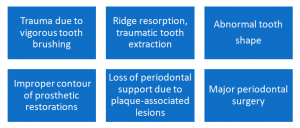 There are two approaches to manage recession of gingiva depending upon the severity.
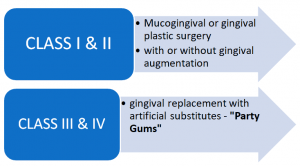 In class III and IV gingival recession, mucogingival surgery is not usually preferred due to its failure to provide optimal aesthetic outcome and may even cause reoccurrence in some cases. Therefore, the preferred option is to make use of the artificial substitutes.
1. Marginal Gingiva
2. Interdental Papilla
Most of the dental procedures aim to reconstruct the whiteentity of a dental restoration i.e. teeth, resulting in an aesthetic failure in patients with unsightly “Black Triangles”.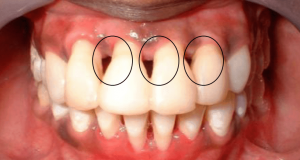 Fig. 1 – The marked areas show areas of “Black Triangles”
The fallout of this condition may result in one of the following
- Difficulty in maintaining oral hygiene
- Altered consonant sound production
- Unaesthetic appearance of a flawless prosthesis
- Negative influence on the outline of the interdental soft tissues
- Further periodontal disease manifestations
What whips up your pink component?
There are two approaches to manage recession of gingiva depending upon the severity. In class III and IV gingival recession, mucogingival surgery is not usually preferred due to its failure to provide optimal aesthetic outcome and may even cause reoccurrence in some cases. Therefore, the preferred option is to make use of the artificial substitutes. Party gums – an alternative to invasive surgical procedures
“Party Gums” is a thin, flexible, silicone or acrylic strip/prosthesis simulating natural gum colour used to mask the anterior defects hampering the aesthetics in a dentition thereby re-establishing the contour of gingiva. It can be fixed or removable and can be made of various materials such as self-cure and heat-cure acrylics, composites, silicone and thermoplastic materials. Keywords: Flange Prosthesis, Black Triangles, Artificial Gums, Party Gums, Gingival Replacement, Gingival Epithesis, Gingival Veneer, Gingival Mask, Aesthetics.Party Gums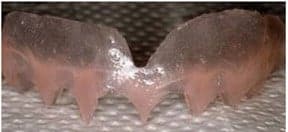
Free for members
Keep reading — it's free
The rest of this article is open to DentalReach members. Create a free account, or sign in, and every article on the site opens in full.

