INTRODUCTION
Modern esthetic dentistry has moved from a preparation-driven philosophy toward a tissue-preserving, evidence-based approach. The clinician is increasingly expected to answer a fundamental question before selecting a restoration: how much healthy tooth structure needs to be removed to achieve the biological, functional and esthetic objectives of treatment?
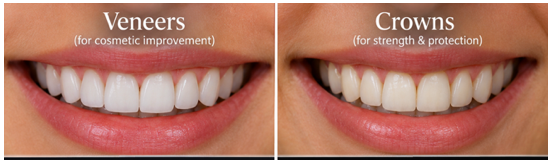
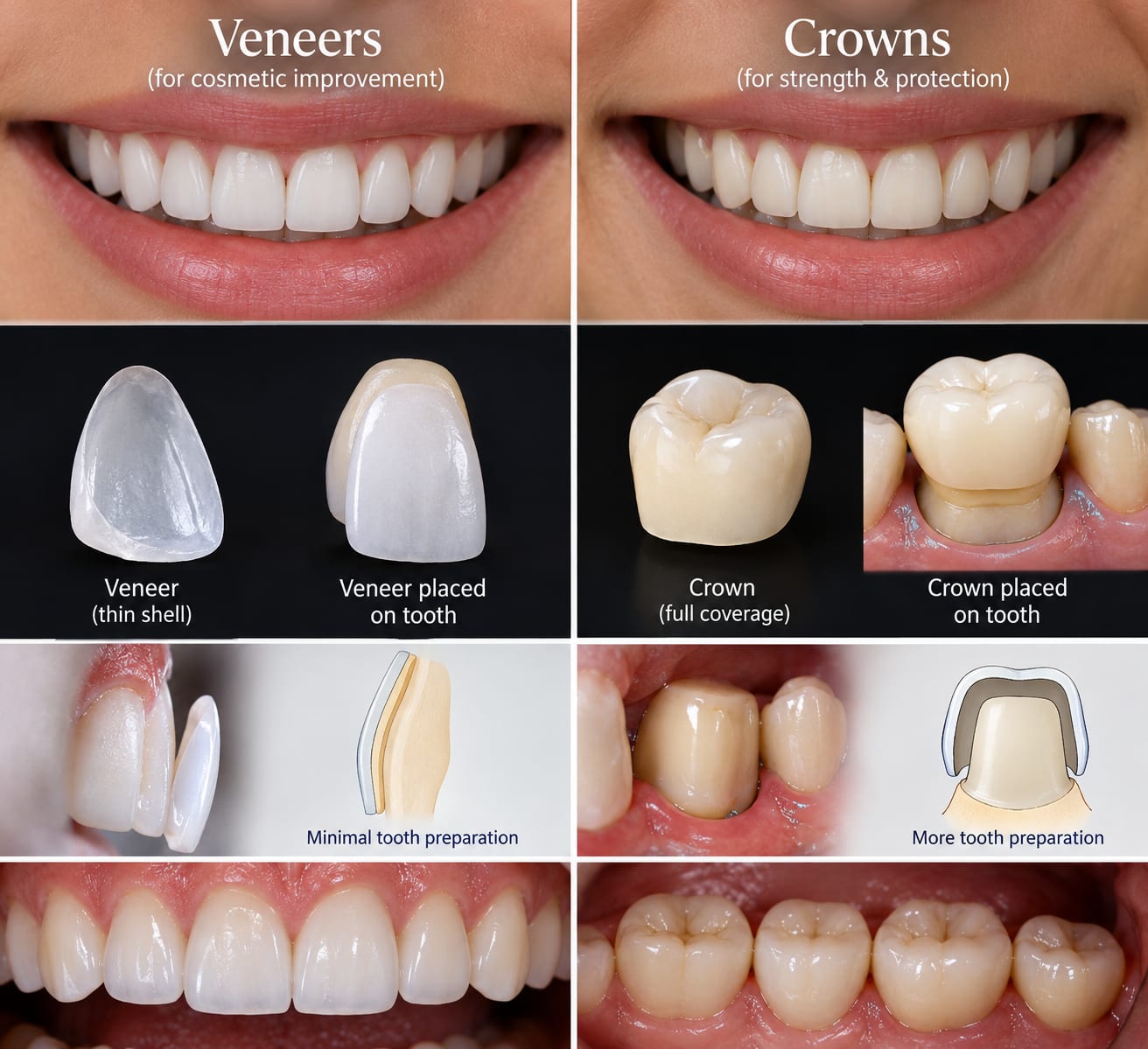
Veneers and crowns may produce similarly impressive changes in colour, shape and tooth proportions, but their biological cost is different. A conventional crown requires reduction around most or all surfaces of the clinical crown, while a well-designed veneer may require little or no preparation in selected cases. This distinction becomes particularly important in young patients, teeth with extensive enamel, and cases where the primary problem is colour, shape or minor positional discrepancy rather than structural weakness. At the same time, 'minimally invasive' should not be interpreted as 'minimal preparation at any cost'. A veneer placed without adequate space may become overcontoured, excessively thin, poorly seated or unable to reproduce the planned shade. Conversely, a crown placed on a structurally compromised tooth may be the more conservative choice in a broader biological sense if it prevents fracture or repeated restorative intervention.
The clinical decision therefore requires integration of esthetic diagnosis, remaining tooth structure, periodontal condition, occlusion, parafunctional activity, endodontic status, ceramic selection and adhesive strategy.
Ceramic Veneer | Full-coverage Crown |
Thin restoration bonded mainly to facial/incisal tooth structure | Restoration covering most or all clinical surfaces of the crown |
Esthetic modification with maximum tissue preservation | Esthetic and/or structural rehabilitation with circumferential coverage |
Primarily anterior teeth; selected premolars | Anterior and posterior teeth |
Usually limited and predominantly enamel-based | Greater reduction in multiple surfaces |
Primarily adhesive | May be adhesive, but conventional mechanical geometry can also contribute |
Discoloration, shape/proportion changes, minor defects, selected diastema closure | Extensive structural loss, large restorations, cracks, severe wear or major morphological alteration |
CASE SELECTION
A patient with intact enamel and an esthetic complaint does not automatically require full coverage. Conversely, a tooth with extensive loss of coronal structure may not be a veneer candidate simply because the patient requests a minimally invasive procedure.
INDICATIONS FOR VENEERS
Intrinsic or extrinsic discoloration that can be predictably masked with the selected ceramic and thickness.
Shape anomalies, peg laterals, incisal irregularities and selected developmental defects.
Minor-to-moderate changes in tooth width, length and facial contour.
Selected diastema closure where tooth proportions and periodontal conditions permit.
Replacement of defective facial restorations when adequate sound enamel remains.
Esthetic rehabilitation of appropriately selected endodontically treated anterior teeth when sufficient sound tooth structure is available.
INDICATIONS FOR CROWNS
Extensive loss of tooth structure from caries, trauma, large restorations or erosion.
Cracks or structural compromise requiring cuspal/circumferential protection.
Severely altered morphology where a veneer cannot provide adequate thickness and contours.
Very dark or severely discolored substrates where predictable masking cannot be achieved conservatively.
Insufficient enamel for predictable adhesive bonding of a veneer.
Functional requirements or occlusal circumstances in which full coverage offers a more predictable design.
VENEER VS CROWN
Tooth conservation is perhaps the clearest conceptual difference. Veneers can often preserve a large proportion of sound enamel, and enamel is a favorable substrate for adhesive bonding. If the preparation moves into dentin, the substrate becomes less ideal for long-term adhesion.
However, conservation is not synonymous with avoiding preparation completely. A no-preparation veneer can create overcontour, periodontal difficulties, improper emergence profile and inadequate ceramic thickness. Diagnostic wax-up, digital planning and mock-up assessment can help determine whether the desired result can be achieved with minimal reduction.
FEATURE | VENEER | CROWN |
Enamel preservation | High when appropriately planned | Lower because multiple surfaces are reduced |
Dentin exposure | Ideally minimized | Usually unavoidable to obtain required reduction |
Biological cost | Generally lower | Generally higher |
Pulpal considerations | Less reduction may mean less pulpal insult | Greater preparation can increase biological risk |
Reversibility | May be relatively conservative, but most prepared veneers are not truly reversible | Irreversible by design |
Periodontal impact | Usually favorable with correct margins and emergence profile | Margin location and contour become more critical |
PREPARATION DESIGN
Preparation should be additive in concept and subtractive only where necessary. The final ceramic thickness, material, shade requirements, occlusion and planned tooth position should be known before preparation begins.
Principles of Veneer Preparations
Use a diagnostic wax-up/mock-up to establish the intended final form.
Create controlled reduction rather than freehand aggressive reduction.
Maintain enamel whenever possible, particularly in the bonding area.
Avoid sharp internal line angles; provide a smooth, cleansable finish line.
Respect periodontal architecture and avoid unnecessary subgingival extension.
Plan incisal coverage according to the restorative design and occlusion rather than using a universal preparation.
Do not prepare deeper simply to hide a colour problem; first evaluate ceramic opacity, thickness and substrate management.
Principles of Crown Preparations
Provide adequate occlusal/incisal and axial reduction for the selected material.
Preserve sound tooth structure and avoid unnecessary extension of the preparation.
Create appropriate taper and a continuous, smooth finish line.
Round internal angles to reduce stress concentration.
Design the preparation to support the ceramic rather than relying on unsupported thin material.
Place margins supragingivally whenever esthetically and biologically possible.
CLINICAL ASPECTS OF BONDING
Bonding is central to veneer success. Adhesive ceramic restorations derive much of their clinical performance from the interaction among ceramic surface treatment, resin cement, adhesive system and tooth substrate. The protocol must therefore be material-specific and strictly controlled.
Bonding to Enamel
Enamel provides a predictable substrate for adhesive dentistry after appropriate etching and adhesive application. Preserving enamel is consequently not only a tissue-conservation goal; it is also a mechanical advantage for an adhesive veneer.
Bonding to Dentin
Dentin is more complex because of its tubular structure, moisture sensitivity and variable bonding performance. When veneer preparations expose substantial dentin, substrate management becomes more demanding and long-term predictability may be affected. Immediate dentin sealing has been investigated as one strategy, although evidence regarding its effect on long-term veneer survival in endodontically treated anterior teeth remains inconclusive.
Surface Treatment of Ceramics
The surface treatment depends on ceramic composition. Etchable silica-based ceramics such as feldspathic porcelain and lithium disilicate are commonly treated using hydrofluoric acid according to the manufacturer's protocol, followed by rinsing/cleaning and application of an appropriate silane or ceramic primer. Polycrystalline zirconia is chemically different and should not be treated as an etchable glass ceramic; air abrasion and an appropriate phosphate-functional monomer strategy may be used according to the material and manufacturer.
Resin cement selection should consider restoration thickness, translucency, shade stability, working time and the clinical situation. Light-cured resin cements are frequently preferred for thin anterior veneers where adequate light transmission is possible; dual-cure systems may be indicated where restoration thickness or opacity limits light transmission.
BONDING CONSIDERATION | VENEER | CROWN |
Adhesion | Usually fundamental to retention and fracture resistance | May be adhesive or rely partly on preparation geometry, depending on material/design |
Enamel | Highly desirable substrate | Important when available, but less dominant because coverage is extensive |
Dentin | Exposure should be minimized | Often present and must be managed predictably |
Ceramic conditioning | Highly material-dependent | Highly material-dependent |
Cement | Often resin cement | Resin, resin-modified or conventional cement depending on material and design |
Isolation | Critical | Important; adhesive crowns are particularly technique-sensitive |
MATERIAL SELECTION
Material selection should follow the clinical indication rather than a single 'best ceramic' concept. Feldspathic ceramics offer excellent optical potential and can be highly conservative when thin, while lithium disilicate provides a useful balance of strength, translucency and adhesive compatibility. Zirconia provides high strength, but its surface treatment and cementation protocol differ from glass ceramics.
Free for members
Keep reading — it's free
The rest of this article is open to DentalReach members. Create a free account, or sign in, and every article on the site opens in full.