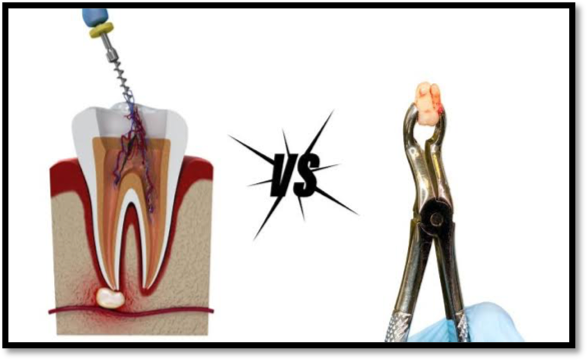
INTRODUCTION
Modern endodontics has evolved considerably which includes Magnification, operating microscopes, nickel-titanium instrumentation, electronic apex locators, advanced irrigation protocols, ultrasonic activation, CBCT imaging in selected cases, bioceramic materials, and improved adhesive restorative techniques have all contributed to better diagnosis and treatment. However, technology cannot compensate for poor case selection.
Therefore, the real clinical question is not simply: “Is root canal treatment better than extraction?” Instead, the appropriate question is:
“For this particular tooth and this particular patient, does preserving the natural tooth provide a better long-term outcome than removing it?”
WHAT DOES ROOT CANAL TREATMENT ACTUALLY ACHIEVE?
Root canal treatment is a procedure designed to manage disease of the dental pulp and periapical tissues while allowing the tooth to remain functional in the oral cavity.
When the pulp becomes irreversibly inflamed or necrotic, microorganisms and their by-products may establish themselves within the root canal system. If left untreated, the disease may progress to apical periodontitis, abscess formation, sinus tract development, bone destruction, and pain. Root canal treatment aims to:
Remove infected or inflamed pulp tissue.
Reduce the microbial load within the root canal system.
Shape the canal system appropriately.
Irrigate and disinfect areas that instruments cannot directly reach.
Seal the root canal system.
Restore the tooth adequately to prevent reinfection and fracture.
IT IS DISEASE CONTROL WHILE PRESERVING THE NATURAL TOOTH.
The first question should always be:
Can this tooth be predictably restored and maintained?
Why Do Dentists Prefer to Preserve Natural Teeth?
The natural tooth is an extraordinarily sophisticated biological and mechanical structure. Although a root-filled tooth no longer contains vital pulp tissue, it still retains:
Its periodontal ligament
Its proprioceptive function
Its root structure
Its relationship with surrounding teeth
Its position within the alveolar bone
Its functional role in mastication
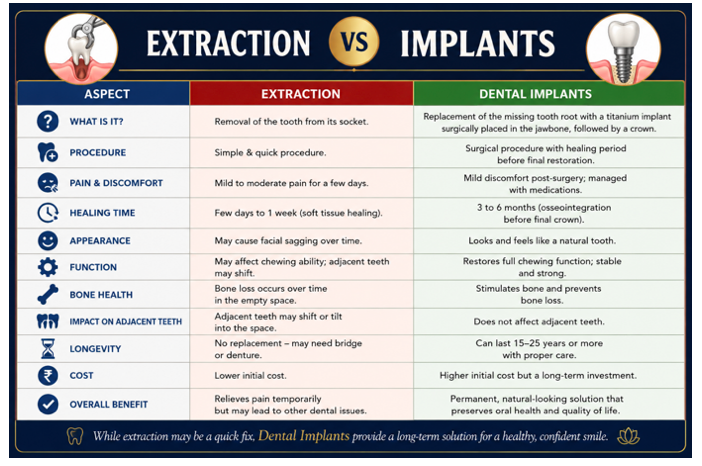
Preserving the natural tooth also avoids the immediate consequences associated with extraction. Once a tooth is removed, the treatment does not necessarily end. The missing tooth may eventually need to be replaced with:
An implant-supported restoration
A fixed dental prosthesis
A removable partial denture
Or, in selected situations, no replacement
Therefore, comparing “root canal treatment” with “extraction” alone can be misleading.
EVENTS FOLLOWING POST EXTRACTION
Extraction removes the diseased tooth, but it also permanently removes the tooth itself. Following extraction, the surrounding tissues undergo biological changes. The alveolar ridge can undergo dimensional changes after tooth removal. This may affect future restorative options, particularly implant placement.
Extraction can also produce changes in:
Adjacent teeth
Neighboring teeth may tilt or drift into the space.
Opposing teeth
The opposing tooth may migrate or over-erupt into the edentulous space.
Occlusion
Changes in tooth position can alter occlusal relationships.
Bone
The alveolar ridge may undergo resorption after tooth loss.
Function
Depending on the location and number of missing teeth, chewing efficiency can be affected.
Esthetics
Loss of anterior teeth can have a significant esthetic and psychological impact.
Thus, extraction should not always be considered the “simple” option.
It may be simple surgically, but it can create a more complex restorative situation later.
Root Canal Treatment Preserves the Natural Tooth
One of the strongest arguments for root canal treatment is straightforward:
It preserves the patient's own tooth.
Natural teeth provide a combination of anatomical, functional, sensory, and biological characteristics that artificial replacements attempt to reproduce.
Even an excellent implant is still an artificial replacement.
When a natural tooth can be predictably treated and restored, retaining it may therefore be a highly conservative approach.
This is particularly important in young patients.
Is Root Canal Treatment Always Better?
No. This is an extremely important point. Root canal treatment should not be performed simply because a tooth is painful or infected. A tooth must first be evaluated for restorability and prognosis.
Extraction may be the better option when there is:
A non-restorable crown
Extensive subgingival destruction
Unfavorable root fracture
Severe periodontal attachment loss
Poor crown-to-root ratio
Severe structural compromise
Inadequate remaining tooth structure
Certain vertical root fractures
Persistent disease associated with an unfavorable prognosis
Inability to isolate and adequately treat the tooth
A patient-specific situation where predictable restoration is impossible
Therefore: Preservation of the natural tooth is desirable—but preservation at any cost is not. The objective is predictable treatment, not simply keeping a questionable tooth in the mouth.
Root Canal Treatment Versus Extraction: The Functional Perspective
Function is one of the strongest reasons to retain natural teeth.
A natural tooth maintains:
Occlusal relationships
Proprioception through the periodontal ligament
Tooth position
Contact relationships
Normal chewing patterns
Extraction immediately removes all of these structures.
An implant can restore many aspects of function remarkably well, but it does not recreate the periodontal ligament in the same way as a natural tooth.
A fixed bridge can replace the missing tooth but involves additional restorative considerations and, traditionally, preparation of adjacent teeth.
A removable prosthesis may provide a replacement but does not function exactly like a natural tooth.
Free for members
Keep reading — it's free
The rest of this article is open to DentalReach members. Create a free account, or sign in, and every article on the site opens in full.