
The New Era of Dental Practice & Education
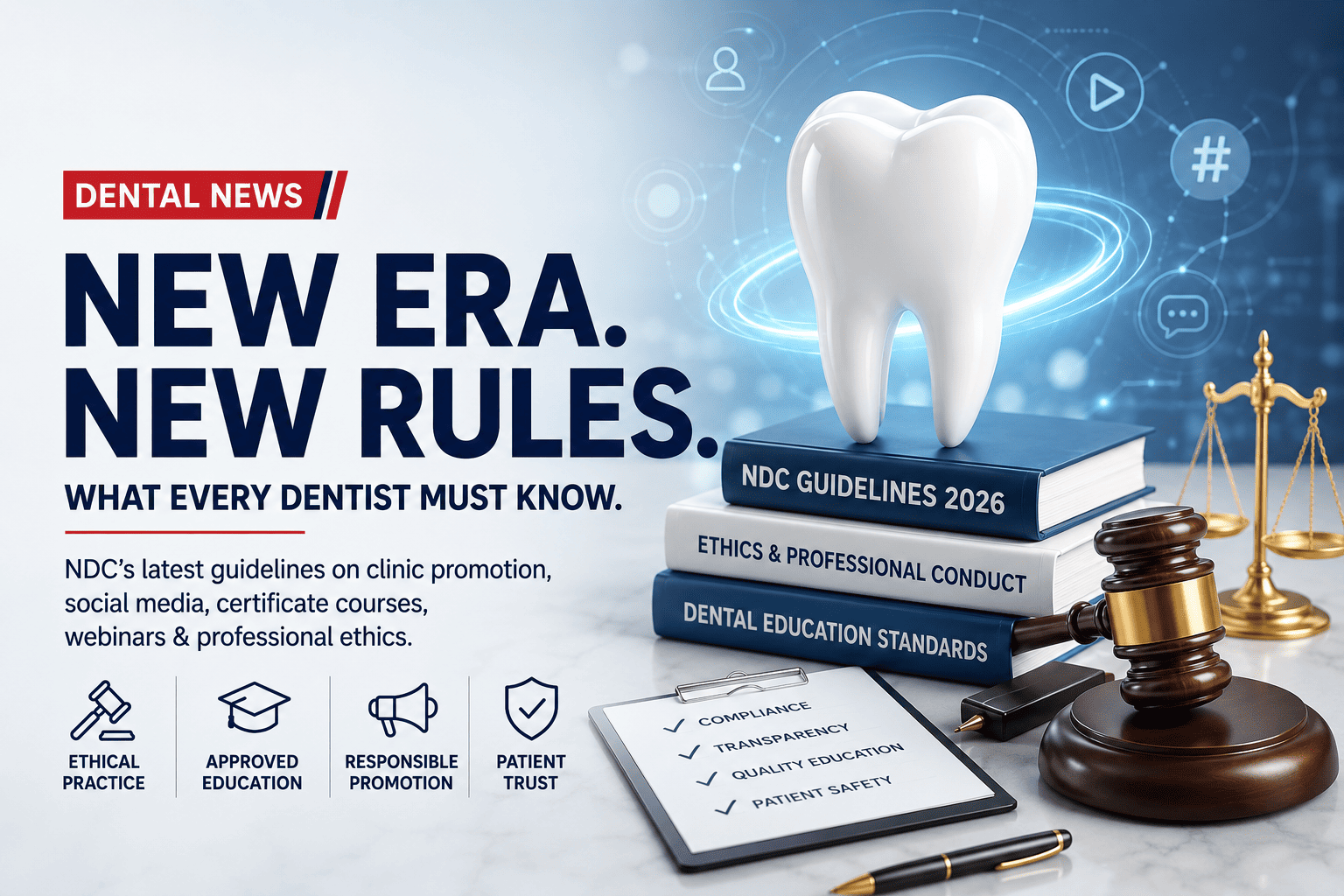
Decoding the National Dental Commission's Latest Guidelines on Clinic Promotion, Social Media, Certificate Courses, Academies & Professional Ethics
What Every Dentist, Academy, Hospital, University, Speaker and Healthcare Entrepreneur Must Know in 2026
Introduction
Dentistry in India is undergoing one of its most significant regulatory transformations since the enactment of the Dentists Act, 1948.
With the implementation of the National Dental Commission (NDC) Act, 2023, the Dental Council of India (DCI) has officially been replaced by the National Dental Commission, ushering in a new era focused on transparency, accountability, ethical practice, and quality assurance in dental education and professional conduct.
While much attention has been given to reforms in dental education and institutional governance, two developments have far-reaching implications for every practicing dentist and dental entrepreneur:
The continued enforcement of the Revised Dentists (Code of Ethics) Regulations, 2014, governing professional advertising, clinic promotion, patient communication, and ethical conduct.
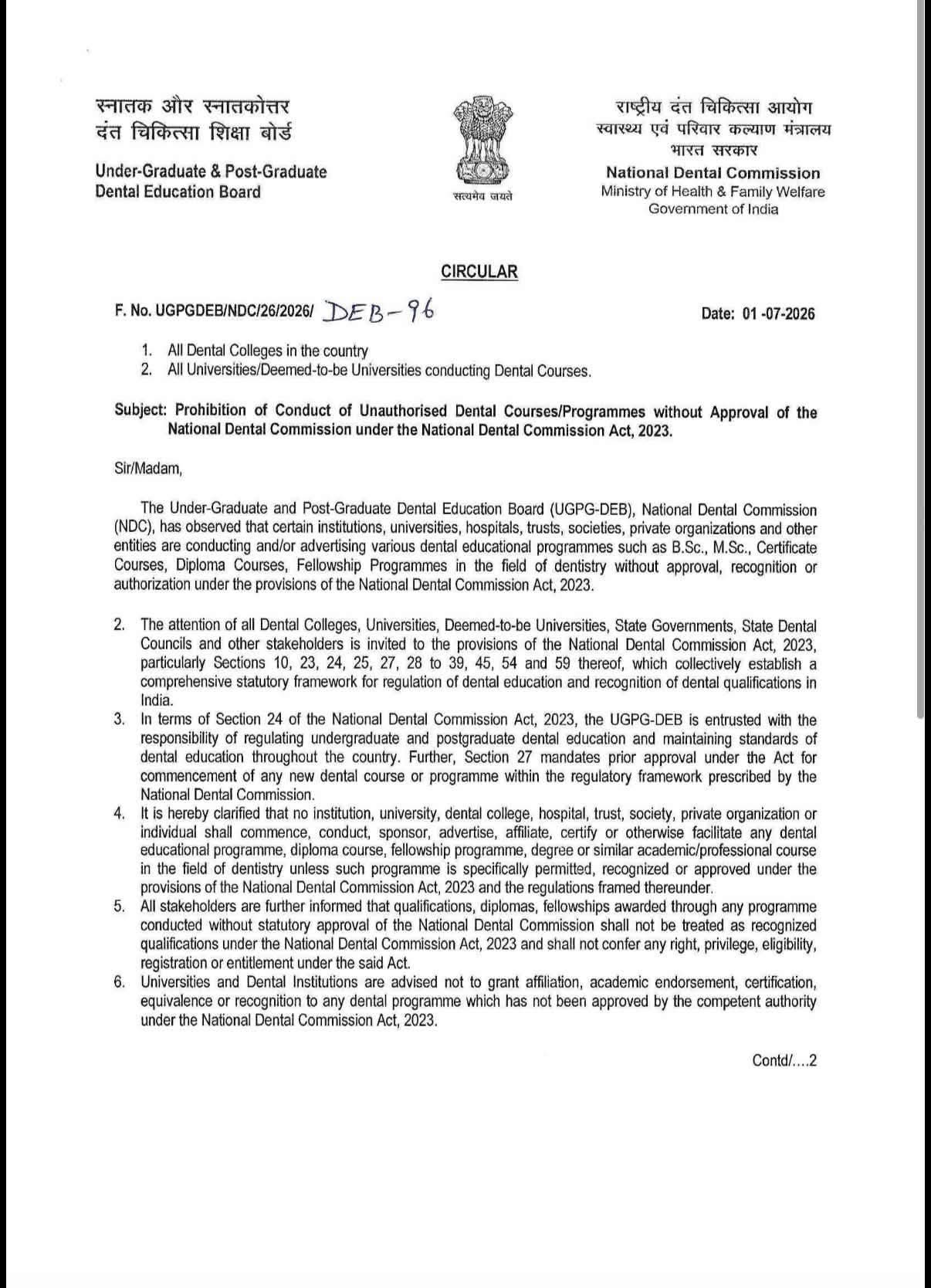
The National Dental Commission Circular (UGPGDEB/NDC/26/2026/DEB-96) dated 1 July 2026, which prohibits the conduct, promotion, sponsorship, certification, or affiliation of unauthorized dental courses and programmes.
Together, these regulations reshape how dentists market their clinics, build personal brands, conduct webinars, organize certificate courses, collaborate with universities, and educate fellow professionals.
Whether you are a general practitioner, specialist, academician, hospital administrator, course organizer, speaker, influencer, or founder of a dental academy, understanding these regulations is no longer optional—it is essential.
Why This Circular Matters
For nearly a decade, private dental education in India has witnessed tremendous growth.
Hands-on implant courses.
Smile design fellowships.
Laser dentistry certifications.
Weekend endodontic workshops.
Online aesthetic dentistry programmes.
Masterclasses.
Fellowships.
International certifications.
Many of these have genuinely contributed to continuing dental education.
However, others have created confusion by advertising themselves as recognized qualifications, specialist credentials, or university-equivalent certifications without statutory approval.
Recognizing this growing concern, the National Dental Commission issued Circular DEB-96 on 1 July 2026, warning institutions against conducting or promoting unauthorized dental educational programmes.
This circular is not merely directed at dental colleges. Its language extends to hospitals, trusts, societies, private organizations, and even individuals.
In other words, almost every organization involved in dental education should review its current activities.
Understanding the NDC Circular DEB-96
The Under-Graduate and Post-Graduate Dental Education Board observed that numerous organizations across India were advertising and conducting:
Certificate Courses
Diploma Courses
Fellowship Programmes
B.Sc. Programmes
M.Sc. Programmes
Dental Educational Courses
without obtaining approval under the National Dental Commission Act, 2023.
The circular therefore reiterates that no institution, university, dental college, hospital, trust, society, private organization or individual shall commence, conduct, sponsor, advertise, affiliate, certify or facilitate any dental educational programme unless specifically recognized or approved under the provisions of the NDC Act.
The circular further clarifies that qualifications, diplomas, fellowships or certificates issued through such unauthorized programmes shall not be treated as recognized qualifications under the National Dental Commission Act.
Who Is Affected?
The circular has implications far beyond dental colleges.
It applies to:
Dental Clinics
Corporate Dental Chains
Private Dental Academies
Implant Training Institutes
Smile Design Academies
Laser Dentistry Centres
Universities
Deemed Universities
Hospitals
Trusts
NGOs
Dental Societies
Continuing Dental Education Providers
International Educational Collaborations
Individual Dentists conducting certificate courses
If your organization conducts educational programmes in dentistry, this circular deserves immediate attention.
What Does "Unauthorized" Actually Mean?
Many dentists misunderstand this point.
An educational programme is not automatically recognized simply because:
It is conducted by senior clinicians, international speakers participate, certificates are issued, a university logo appears, overseas faculty are involved, hundreds of dentists have attended previous batches.
Recognition under the NDC Act depends upon statutory approval—not popularity.
A certificate of participation or completion is fundamentally different from a nationally recognized dental qualification.
Implications for Dental Academies
Private academies have played an important role in skill enhancement.
However, moving forward they must ensure that their promotional material does not create the impression that participants acquire legally recognized qualifications.
Academies should clearly distinguish between:
Skill enhancement programmes
Continuing education
Workshops
Masterclasses
Hands-on training
and
Recognized qualifications
Approved postgraduate education
Accredited fellowship programmes
Transparency is likely to become one of the defining expectations under the new regulatory framework.
What About Workshops and Webinars?
The circular does not prohibit knowledge sharing.
Dentists remain free to organize:
Scientific lectures
Clinical demonstrations
Hands-on workshops
Continuing Dental Education (CDE)
Conferences
Live surgeries
Online webinars
Panel discussions
However, problems arise when these educational activities are advertised as recognized qualifications or specialist certifications without statutory approval.
Social Media Promotion: Where Do Dentists Stand?
Modern dentistry increasingly relies on digital communication.
The Revised Dentists (Code of Ethics) recognizes changing global practices but emphasizes that advertising must always preserve the dignity of the profession.
Generally Acceptable
Oral health awareness
Educational reels
Clinical tips
Preventive dentistry campaigns
New technology
Practice updates
Team introductions
Community outreach
Scientific achievements
Public education
High-Risk Practices
"Best Dentist"
"No.1 Implantologist"
Guaranteed Results
Fake reviews
Patient testimonials used as advertisements
Misleading claims
Comparative advertising
Unrealistic promises
Discount-driven commercialization
Professional education is encouraged.
Commercial solicitation is not.
Websites and SEO
Many dentists incorrectly assume SEO is unethical.
In reality, factual websites are specifically recognized under the ethical framework.
Permissible website content includes:
Dentist qualifications
Services offered
Technology used
Appointment booking
Clinic timings
Fees (when transparently disclosed)
Patient education
Blogs
Oral health articles
However, websites should never include misleading claims, fabricated awards, false success rates, or unrecognized specialist titles.
Google Reviews
Patient feedback naturally forms part of healthcare.
However dentists should never:
purchase reviews
exchange gifts for reviews
manipulate ratings
create fake testimonials
Authenticity remains central to ethical online reputation management.
Before-and-After Images
One of the most debated topics in dental marketing concerns before-and-after photographs.
While these may serve educational purposes in scientific presentations with informed patient consent, using them as promotional advertisements can create unrealistic expectations and may conflict with professional ethical standards.
Clinical documentation should never become commercial exploitation.
Certificate Courses and Professional Titles
Perhaps the most significant practical implication of the new circular concerns certificate courses.
Many practitioners display titles such as:
Certified Implantologist
Certified Smile Designer
Certified Laser Dentist
Fellowship in Aesthetic Dentistry
Dentists should carefully distinguish between:
completion certificates, continuing education, institutional fellowships, and qualifications recognized under statutory regulations.
Any title displayed before the public should not misrepresent the practitioner's legally recognized qualifications.
Responsibilities of Speakers and Key Opinion Leaders
Educational speakers influence thousands of dentists.
With this influence comes responsibility.
Speakers should ensure that:
course advertisements remain truthful, learning outcomes are realistic, certificates are accurately described, affiliations are genuine, university collaborations are legitimate, promotional material avoids misleading terminology.
Scientific credibility is built through integrity—not marketing exaggeration.
What Happens if an Institution Violates the Circular?
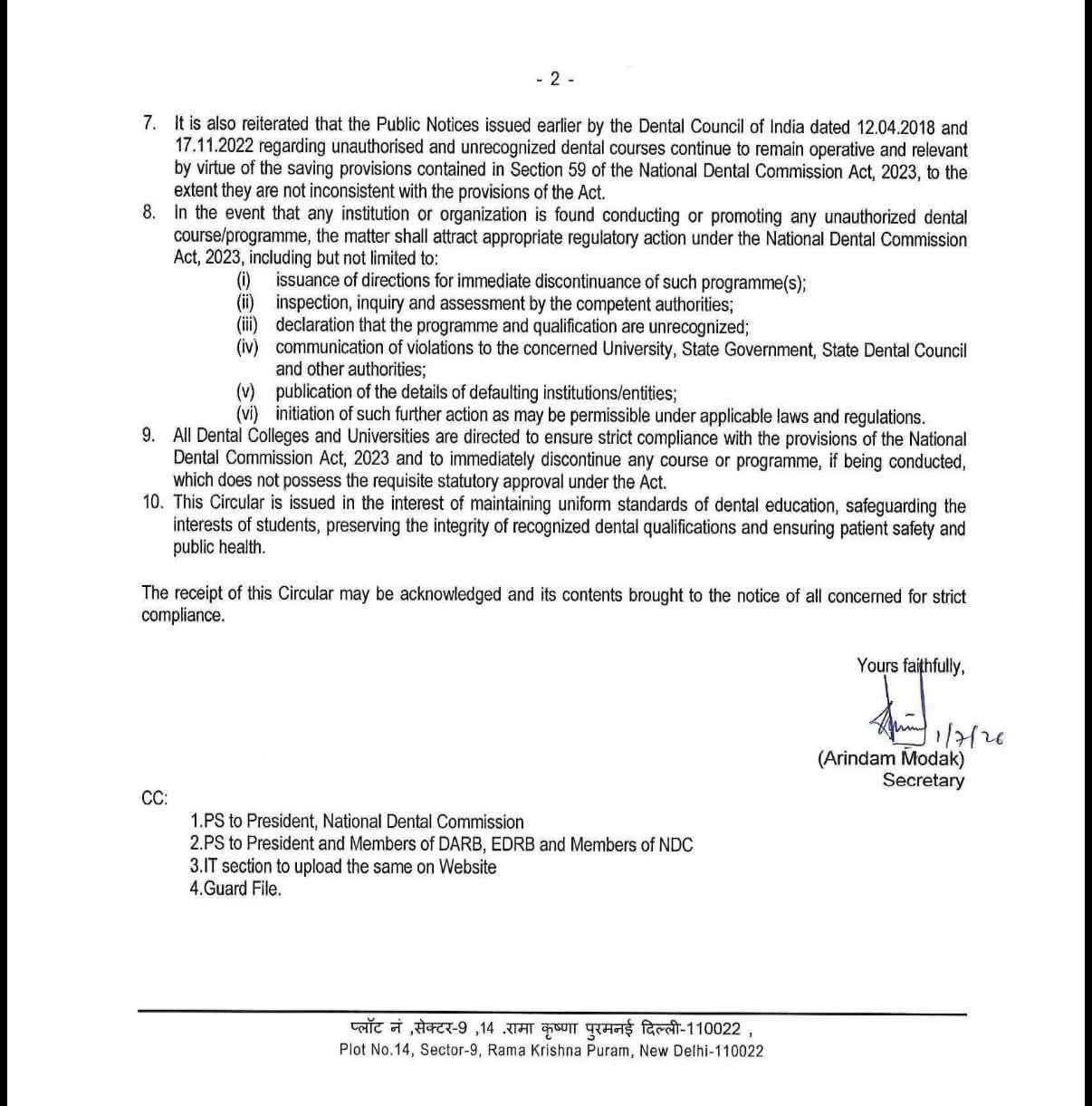
According to the NDC Circular, regulatory action may include:
Immediate discontinuation of programmes
Inspection and inquiry
Declaration that the programme is unrecognized
Communication with universities and State Dental Councils
Publication of details of defaulting institutions
Further action under applicable laws and regulations
These measures demonstrate the Commission's intent to preserve the integrity of dental education and protect students from misleading qualifications.
Practical Compliance Checklist
Before advertising any dental educational programme, ask:
Is the programme approved where approval is required?
Are all affiliations genuine?
Does the advertisement clearly describe the nature of certification?
Are participants likely to misunderstand the qualification?
Is the programme being marketed as continuing education rather than a recognized degree?
Are faculty credentials accurately represented?
Does the promotional material comply with the Revised Dentists (Code of Ethics)?
Looking Ahead
The National Dental Commission is gradually moving dentistry toward a more transparent, accountable, and globally aligned regulatory ecosystem.
For practicing dentists, ethical marketing will continue to evolve—not disappear.
Educational content, patient awareness, digital communication, professional branding, and technological innovation will remain integral to modern dental practice.
The difference lies in intent.
Professional education builds trust.
Misleading promotion erodes it.
Similarly, continuing education remains indispensable for lifelong learning.
However, certificates must accurately represent learning—not regulatory recognition.
The latest NDC circular is therefore not simply a restriction. It is an invitation to strengthen the credibility of Indian dental education while safeguarding both students and patients.
Dentists, educators, and institutions that embrace transparency today will be better positioned to thrive in tomorrow's regulatory landscape.
Explore more with DentalReach
Read the DentalReach dental magazine for professional perspectives, browse clinical dental articles for practical learning, and follow dental news for updates across the profession. You can also read our dental magazine editions.
Continue learning through dental events and conferences, listen to dental podcasts featuring professional conversations, and exchange questions and experiences in our dental forums.
For your next career step, explore dental jobs and opportunities across dental practices and organizations.