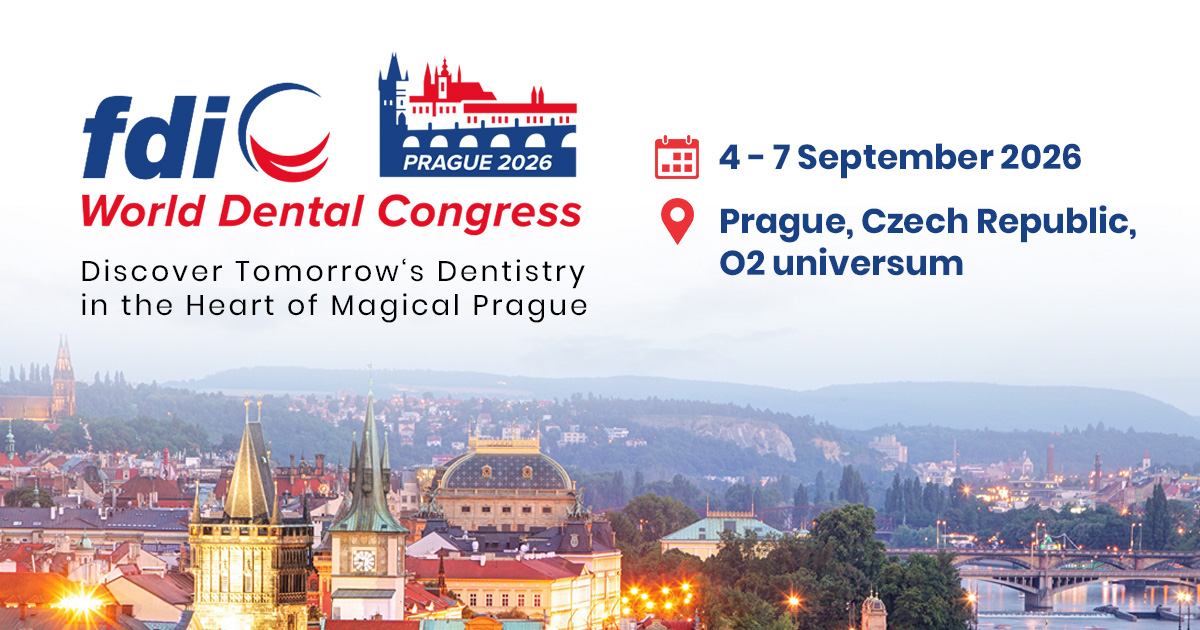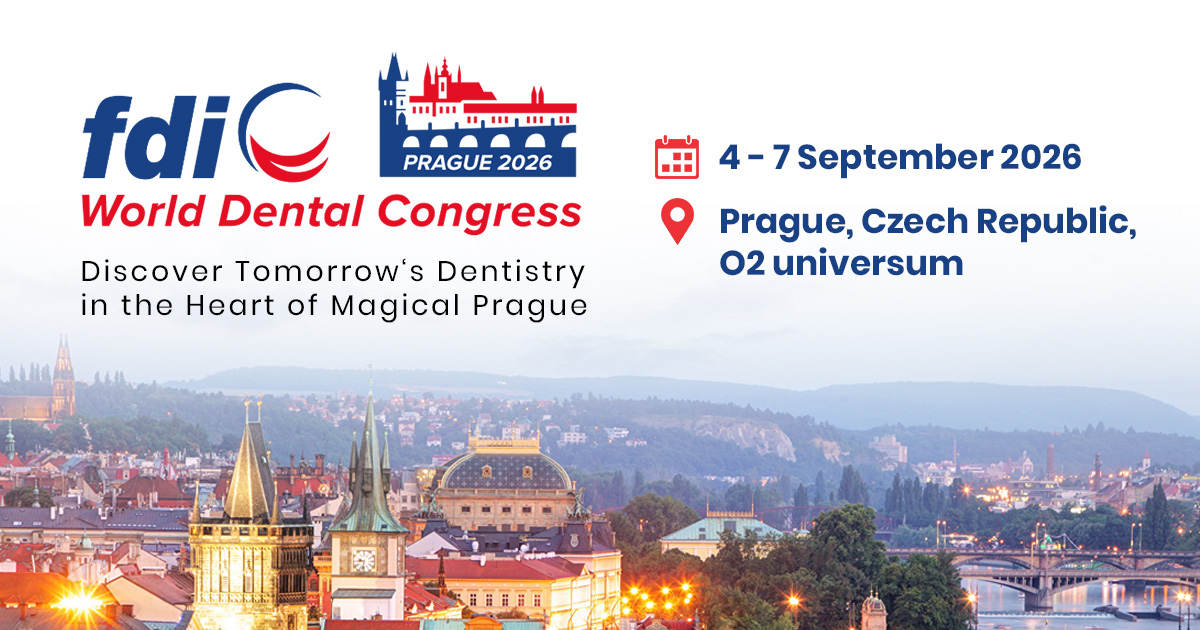
Geneva, Switzerland, 24 March 2026–The FDI World Dental Congress(WDC) 2026 will take place in Prague from 4–7 September 2026, bringing the global dental community together for four days of learning, inspiration, networking and a front-row view of the innovations reshaping oral healthcare. Co-hosted by the FDI World Dental Federation (FDI) and the Czech Dental Chamber, the congress will welcome leading experts from around the worldto explore how dentistry is evolving in the age of artificial intelligence, digital innovation, robotics and patient-centred care.
“Oral healthcare is entering a period of significant change, where clinical decisions are increasingly shaped by new tools,new evidence and rising patient expectations. The FDI World Dental Congress offers an opportunity for dentists from around the worldto reflect on these shifts and prepare for the next chapter of the profession,” stated Dr Antonio EstradaValenzuela, Chair of the FDI Education Committee.
Artificial intelligence will be one of the defining themes of the Prague congress, reflecting its fast-growing role in diagnostics and clinical decision support. As AI moves from research into everyday dental practice, the programme will examine how these tools can help clinicians detect caries, endodontic pathology and periodontal bone loss with greater consistency and speed. Dr Antonin Tichy will present a clinician-focused perspective on evaluating diagnostic AI systems, Prof. Sergio Uribe will address the importance of high-quality clinical data in building reliable tools, and Dr Peter Fritz will explore how AI can support clinical decision-making while preserving professional judgement and patient trust.
“Artificial intelligence has enormous potential in dentistry, but its impact will depend on how well clinicians understand and evaluate these systems. As AI becomes part of everyday practice, education and critical assessment will be key to ensuring thesetools effectively support clinical decisions and better care for patients,” remarked Prof. Falk Schwendicke,co-chair of the WDC 2026 Scientific Programme Committee.
The congress will also spotlight the rise of advanced surgical technologies. In a dedicated session, Dr Kwok Fai James Chow will examine robotic-assisted implant placement, discussing its promise for sub-millimetre precision as well as the practical questions of cost, training and long-term evidence. In this way, Prague 2026 will not simply describe the future of dentistry—it will show how that future is already entering clinical reality.
At the same time, the scientific programme strongly reflects another major priority in modern dentistry: preserving natural teeth whenever possible. Prof. Katrin Bekes will address molar incisor hypomineralisation as a growing worldwide burden affecting children and posing complex treatment decisions for clinicians. Other sessions will explore vital pulp therapy and modern endodontic techniques aimed at preserving natural teeth, with Prof. Talal Al-Nahlawi, Dr Domenico Ricucci and Prof. Alexis Gaudin discussing how deeper understanding of pulp biology and modern biomaterials is enabling more conservative approaches to care. In complex treatment planning cases, Prof. Niklaus Lang, Prof. Howard Gluckman and Dr Syngcuk Kim will offer perspectives on balancing tooth preservation with implant-supported rehabilitation.
The future of the profession will also be addressed through the FDI Young Dentists Forum. In a dedicated session, leadership coach and former practice owner Dr Christina Radics will discuss work–life harmony, resilience and burnout prevention, offering practical strategies to support sustainable careers in dentistry. This focus underlines a broader ambition of the congress: not only to present the latest science, but also to strengthen the profession and the people who will lead it in the years ahead.
Free for members
Keep reading — it's free
The rest of this article is open to DentalReach members. Create a free account, or sign in, and every article on the site opens in full.