
Endodontics

Endodontic Retreatment Cases: A Comprehensive Review

Root canal retreatment cases are performed when a previously treated tooth continues to show pain, infection, swelling, or failure to heal properly. Common reasons for retreatment include missed canals, inadequate cleaning, leakage from a faulty restoration, or reinfection due to recurrent decay. During retreatment, the old filling material is removed, the canals are cleaned and disinfected again, and the tooth is sealed properly to improve long-term success. Early diagnosis and careful case selection are important for achieving a favorable outcome.

Dr Aishwarya Arya

Dr Aishwarya Arya

Attending Consultant · Medanta Hospitals Gurgaon

7 min read125,637 views
  • microbial infection
  • procedural errors
  • professional education
  • retreatment techniques
  • dentistry
  • diagnostic imaging
  • root canal failure
  • cbct
  • Endodontics
  • Clinical & Academic Article

Abstract

Endodontic retreatment is a well-established procedure aimed at managing cases where primary root canal treatment (RCT) has failed. Despite advancements in endodontic techniques and materials, failures still occur due to microbial persistence, anatomical complexities, and technical errors. This review provides a detailed overview of indications, causes of failure, diagnostic tools, clinical precautions, and success rates of nonsurgical retreatment. Emphasis is placed on evidence-based approaches and modern diagnostic aids such as CBCT and magnification systems. Understanding these factors is critical for improving prognosis and ensuring long-term tooth preservation.

Introduction

Root canal treatment (RCT) is one of the most predictable procedures in dentistry, with success rates often exceeding 85–90%. The primary objective of RCT is the elimination of microorganisms from the root canal system and prevention of reinfection. However, due to the complex anatomy of the root canal system and limitations in clinical procedures, complete disinfection is not always achieved. As a result, failure of primary treatment may occur, necessitating retreatment. Endodontic retreatment involves the removal of previous obturation material, reinstrumentation, disinfection, and reobturation of the canal system. It is considered a conservative and preferable option compared to surgical intervention or extraction, particularly when the tooth is structurally sound and periodontally stable.

Failure of Root Canal Treatment

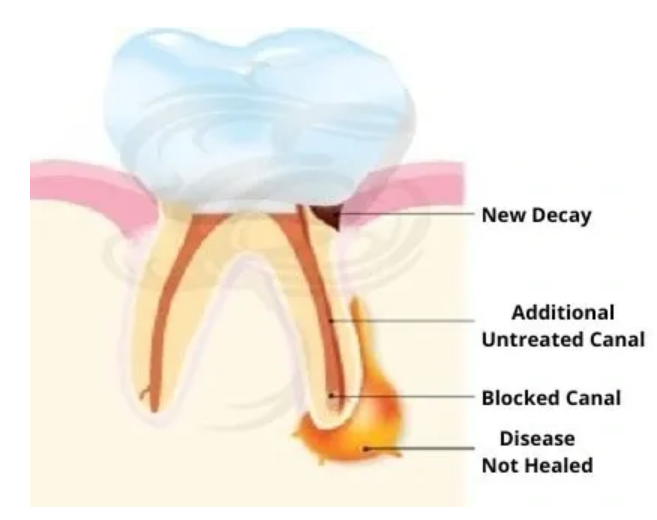
Failure of root canal treatment is characterized by the persistence of symptoms such as pain, swelling, tenderness or the presence of periapical radiolucency. The most common cause of failure is

1.Persistent intraradicular infection

2.Associated with resistant microorganisms such as Enterococcus faecalis.

3.Missed canals

4.Inadequate cleaning and shaping

5.Poor obturation

6.Coronal leakage.

7.Procedural errors such as ledge formation, transportation, perforation, or instrument separation may also compromise treatment outcomes.

In many cases, failure is multifactorial, involving both biological and technical aspects.

Indications for Retreatment

Endodontic retreatment is indicated when there is evidence of persistent or recurrent disease associated with a previously treated tooth. Clinical signs such as pain on percussion, swelling, or sinus tract formation indicate ongoing infection. Radiographically, the presence of persistent or enlarging periapical lesions suggests failure of initial therapy. Retreatment is also indicated in cases of inadequate obturation, missed canals, or coronal leakage due to defective restorations. Proper case selection is essential, and factors such as restorability and periodontal status must be carefully evaluated before proceeding.

Diagnostic Tools

Accurate diagnosis is critical for successful retreatment. Clinical examination includes assessment of symptoms, periodontal probing, mobility, and sinus tract tracing. Radiographic evaluation using intraoral periapical radiographs provides initial information; however, two-dimensional imaging has limitations. Cone Beam Computed Tomography (CBCT) has significantly improved diagnostic accuracy considered to be gold standard by providing three-dimensional visualization of periapical lesions, root canal anatomy, and procedural complications. The use of dental operating microscopes enhances visualization and allows detection of missed canals and microcracks. Together, these diagnostic tools improve treatment planning and outcomes.

Precautions During Retreatment

Retreatment procedures are technically demanding and require careful execution. Preoperative assessment should include evaluation of case difficulty and patient factors. During treatment, excessive removal of dentin should be avoided to prevent weakening of the tooth structure. Careful removal of previous obturation material is essential to avoid procedural errors such as perforation. Maintenance of working length and apical patency is critical for effective cleaning and shaping. Adequate irrigation using sodium hypochlorite and EDTA enhances disinfection. Postoperatively, a proper coronal seal must be ensured to prevent reinfection. Placement of a definitive restoration, such as a crown, significantly improves long-term prognosis.

Success Rate and Prognosis

The success rate of endodontic retreatment varies depending on several factors, including the presence of periapical pathology, quality of previous treatment, and operator skill. Studies report success rates ranging from 70% to 88%. Teeth without periapical lesions tend to have higher success rates compared to those with existing pathology. However, even teeth with lesions can heal successfully if proper disinfection is achieved. The use of advanced techniques such as CBCT and rotary instrumentation has further improved outcomes. Prognosis is generally favorable when retreatment is performed under proper aseptic conditions with adequate coronal restoration.

Here’s a well-structured, detailed note you can directly add to your article on Endodontic Retreatment. The success of non-surgical endodontic retreatment has been widely studied and is influenced by multiple biological, technical, and patient-related factors. In general, retreatment aims to eliminate persistent or secondary infection and achieve periapical healing, similar to primary root canal therapy.

Reported success rates for re-RCT vary in the literature, typically ranging between 60% and 88%, which is slightly lower than primary root canal treatment (90–95%). The variability depends on preoperative conditions, quality of previous treatment, and procedural factors.

A key determinant of success is the periapical status of the tooth prior to retreatment. Teeth without periapical radiolucency demonstrate higher success rates (up to 85–90%), whereas teeth with existing periapical lesions show comparatively reduced success (approximately 60–75%). However, even in the presence of lesions, significant healing can be achieved with proper disinfection and obturation.

Another critical factor is the quality of the previous root canal filling. Cases with poorly filled canals (underfilled, overfilled, or with voids) tend to have better retreatment outcomes because the cause of failure is often microbial and correctable. In contrast, failures due to procedural errors such as ledge formation, perforations, or separated instruments may reduce prognosis.

The coronal seal also plays an essential role. Studies show that teeth with adequate post-retreatment coronal restoration exhibit significantly higher long-term success due to prevention of reinfection.

Advanced techniques such as the use of operating microscopes, ultrasonic instruments, rotary retreatment files, and enhanced irrigation protocols (e.g., NaOCl activation, EDTA) have improved the predictability of retreatment outcomes in modern endodontics.

Long-term follow-up is crucial, as healing of periapical tissues may take 6 months to 4 years, depending on lesion size and host response. Radiographic and clinical evaluation over time is necessary to confirm true success.

In comparison to surgical endodontics, non-surgical retreatment is generally preferred as the first line of management due to its conservative nature and favorable success rates.

Although slightly less predictable than primary RCT, endodontic retreatment remains a highly effective procedure when proper case selection, disinfection, and restoration principles are followed.

Retreat the cause—not the radiograph alone

Persistent disease after root canal treatment may reflect missed anatomy, inadequate disinfection, leakage, fracture, perforation, resorption or a non-endodontic diagnosis. Before retreatment, confirm restorability and periodontal prognosis, identify the likely cause and compare nonsurgical retreatment, surgery, monitoring and extraction. CBCT should be selected when the added information is expected to change management.

DecisionAssessPlanning consequence
RestorabilityRemaining structure, crack and ferruleDo not retreat a hopeless tooth
Cause of failureMissed canal, leakage, procedural issueTarget the correct problem
Technical feasibilityPosts, separated instruments and anatomyPlan equipment or referral
Patient goalRisk, alternatives, cost and timeShared decision

Continue with AI prognosis evidence, post-treatment cold sensitivity and persistent exudation management.

Frequently asked questions

Does every apical radiolucency need retreatment?

No. Timing, symptoms, healing trend, diagnosis and technical quality guide management.

Is CBCT required for every retreatment?

No. Use it selectively when three-dimensional information may change care.

When is referral appropriate?

Refer when diagnosis, anatomy, post removal, complications or surgery exceed available expertise.

Conclusions

Endodontic retreatment plays a vital role in preserving natural dentition and managing failed root canal cases. With advancements in diagnostic tools and treatment techniques, clinicians can achieve predictable outcomes. Proper case selection, adherence to clinical protocols, and use of modern technology are key to success. Retreatment should always be considered before opting for surgical or extraction procedures, as it provides a conservative and effective solution.

References

  1. [1]Ng YL, Mann V, Gulabivala K. Outcome of secondary root canal treatment: a systematic review Int Endod J.. 2026
  2. [2]Torabinejad M, Corr R, Handysides R, Shabahang S. Outcomes of nonsurgical retreatment and endodontic surgery: a systematic review J Endod.. 2026
  3. [3]Salehrabi R, Rotstein I. Endodontic treatment outcomes in a large patient population J Endod.. 2026
  4. [4]Friedman S, Mor C. The success of endodontic therapy—healing and functionality J Calif Dent Assoc.. 2026
  5. [5]Siqueira JF Jr. Aetiology of root canal treatment failure Int Endod J.. 2026
  6. [6]Ricucci D, Siqueira JF Jr. Biofilms and apical periodontitis J Endod.. 2026
  7. [7]Gorni FG, Gagliani MM. The outcome of endodontic retreatment J Endod.. 2026
  8. [8]Almufleh LS. Outcomes assessed by CBCT Saudi Dent J.. 2026
  9. [9]Bhatt P, et al. Retreatment outcomes J Endod.. 2026

Written by

Dr Aishwarya Arya

Dr Aishwarya Arya

Attending Consultant · Medanta Hospitals Gurgaon