
Abstract
One of the oldest and most prevalent disorders affecting people is dental caries. Newer approaches stress disease prevention and the preservation of tooth structure in light of the recent transition from the surgical model of disease management, which placed an emphasis on restorative therapy; to a medical model of disease management. Instead of waiting until a cavity forms and restorative therapy is required, this article discusses devices like DIAGNOdent, Digital Imaging Fiber-Optic Transillumination, quantitative light-induced fluorescence, and the Electronic Caries Monitor, used for early identification and monitoring of caries. Caries prevention strategies including oral hygiene practises, fluoridation, pit-and-fissure sealants, xylitol use, the development of a dental caries vaccine, and the role of the infant's primary caregiver are also discussed. Key words: Dental caries, Risk assessment, Prevention, Diagnosis, and DetectionIntroduction
Dental caries, a prevalent and persistent disorder, has historically been managed through surgical interventions involving decay removal and cavity filling. However, this approach often led to the progression of larger cavities and eventual tooth loss, particularly in lower socioeconomic groups. Recent advancements have shifted focus towards disease prevention and tooth structure preservation, transitioning from a surgical to a medical strategy. (1-3) The development of dental caries is rooted in the transformation of oral biofilm microbiota due to frequent consumption of fermentable carbohydrates. This leads to the formation of an acidogenic, aciduric, and cariogenic biofilm population, causing erosion of dental hard tissues and the eventual formation of carious lesions. Dental caries is therefore viewed as a dietary-microbial disease, necessitating the presence of a cariogenic biofilm and regular exposure to fermentable carbohydrates. Fluoride plays a crucial role in prevention by aiding in remineralization and preventing demineralization, underscoring the importance of sufficient fluoride exposure in combating the disease. (4-7) Early Childhood Caries (ECC) primarily affects primary teeth, particularly the maxillary anterior teeth, and is often triggered by prolonged exposure to sweetened beverages, especially before sleep or frequent consumption throughout the day. ECC risk factors include pre-existing enamel hypoplasia and the vulnerability of newly erupted upper incisors, followed by molars and canines. Rampant caries, characterized by extensive decay, affects multiple tooth surfaces and is associated with factors such as xerostomia, poor oral hygiene, stimulant usage, and high sugar consumption. Additionally, radiation-induced caries can occur after head and neck radiation therapy. The development of caries at both individual and community levels is influenced by various factors, including bacterial colonization, family demographics, oral health practices, community dynamics, and access to dental care (8-14). Molar-Incisor Hypomineralization (MIH) is marked by qualitative enamel defects, primarily affecting first permanent molars and associated incisors. Reduced activity of enamel-forming cells during enamel matrix formation and mineralization phases leads to the development of pits or grooves, presenting as hypoplasia or hypomineralization. Diagnostic criteria for MIH, including demarcated opacities and enamel breakdown, were established by the European Academy of Paediatric Dentistry in 2003 (15-18).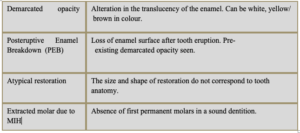
Stages & Symptoms of Dental Caries
Progresses from initial mineral loss to irreversible cavity formation. (6) l Stage of White Spots: Acid from bacteria destroys the mineral matrix of teeth, leading to the formation of chalky white patches on the tooth surface. At this stage, the lesion is reversible, and the surface remains intact. Distinguishing between early caries-induced white spots and developmental hypocalcification can be challenging. l Cavity Stage: If mineral loss continues, the tooth surface eventually breaks or "cavitates," resulting in irreversible damage. At this point, the lesion cannot be repaired, and large tooth areas may be lost. Active cavitated lesions typically appear golden brown, while long-lasting lesions may darken, sometimes appearing almost black. However, the color depth is not always indicative of lesion severity, as stopped decay can also be dark. (19) Symptoms and signs of dental caries vary depending on the cavity size and location: (20)- Toothache and dental sensitivity, especially after consuming sweet, hot, or cold foods or beverages.
- Visible cracks or holes in teeth.
- Brown, black, or white stains on tooth surfaces.
- Bad breath and unpleasant tastes.
Dental caries Detection and Prevention
Advancements in dental caries risk analysis and prediction have shifted focus from immediate cavity filling to managing plaque and promoting remineralization, thereby potentially reversing the caries process. (22) Traditional methods of caries diagnosis, such as radiography, tactile sensation, and visual inspection have limitations, particularly in detecting early enamel caries and assessing disease progression. However, recent technological innovations offer promising alternatives for early lesion detection and monitoring.(23)- Laser fluorescence technology, exemplified by DIAGNOdent (24), enables the measurement of bacterial products in caries lesions with high sensitivity, aiding in the identification of early demineralization.
- Digital Imaging Fiber-Optic Transillumination (DIFOTI) (25) utilizes fiber-optic light to quantitatively characterize caries processes, potentially identifying early demineralization, fissures, or fractures.
- Similarly, Quantitative Light-Induced Fluorescence (QLF) (26)leverages enamel fluorescence under specific lighting conditions to detect demineralized areas
- The Electronic Caries Monitor (ECM) detects variations in electrical impedance between sound and demineralized enamel.
Free for members
Keep reading — it's free
The rest of this article is open to DentalReach members. Create a free account, or sign in, and every article on the site opens in full.

