
INTRODUCTION
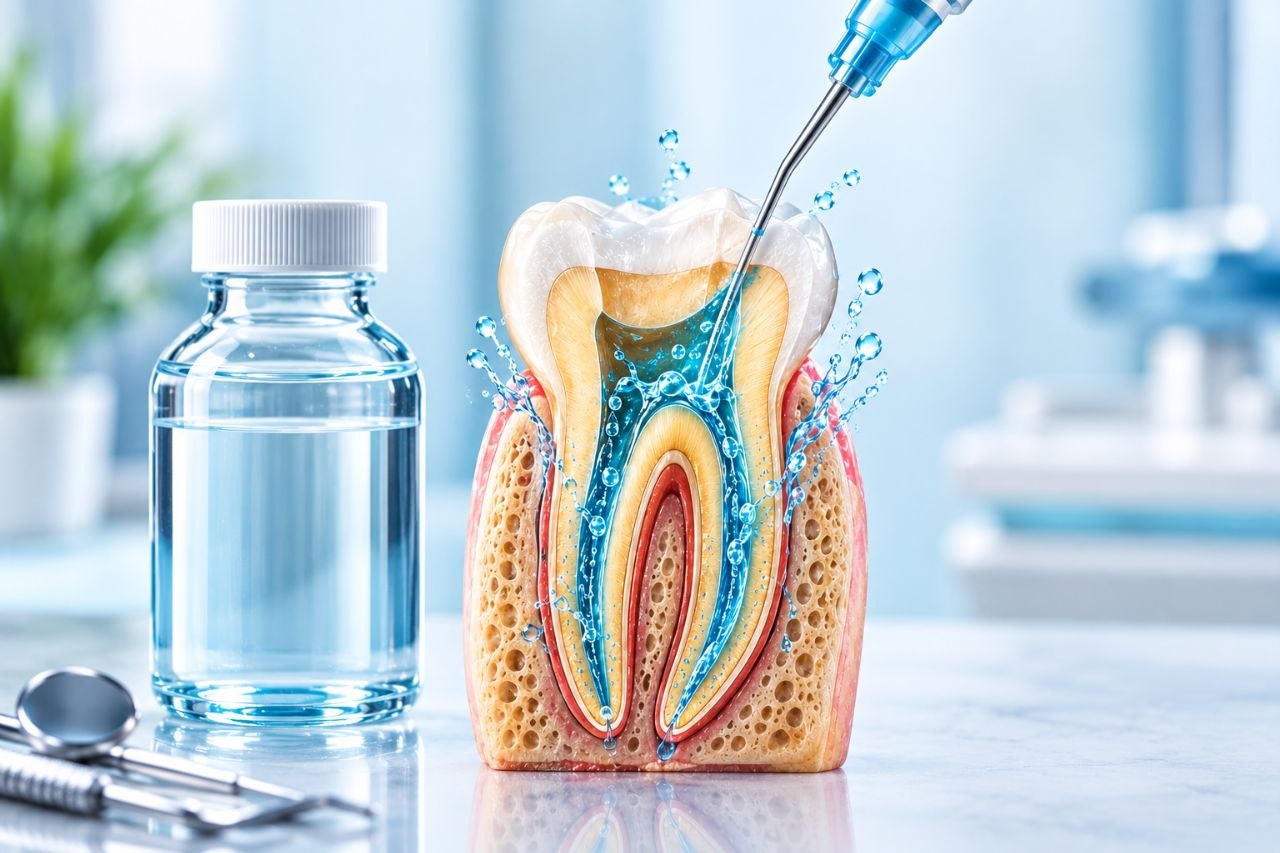
Successful endodontic treatment depends not only on mechanical instrumentation but also on effective chemical debridement of the root canal system. The complex anatomy of canals contains fins, isthmuses, lateral canals, and irregularities that instruments cannot completely contact. Irrigants therefore play a critical role in reaching areas beyond the physical limits of instrumentation.
Among the available solutions, sodium hypochlorite has remained the cornerstone of root canal irrigation for decades. Its broad antimicrobial spectrum and ability to dissolve organic tissues make it particularly valuable during root canal preparation. In simple terms, instrumentation shapes the canal, while NaOCl helps clean what the instruments cannot reach.
FACTORS AFFECTING THE EFFECTIVENESS OF SODIUM HYPOCHLORITE
The performance of sodium hypochlorite is influenced by multiple variables.
Concentration- Concentration is one of the most discussed factors affecting NaOCl performance. 5.25 % has been considered most effective for different clinical conditions in endodontics. In general, increasing the concentration can increase:
Antimicrobial activity
Tissue dissolution
Chemical reactivity.
However, greater concentration is also associated with greater potential cytotoxicity. This creates an important clinical balance. The objective is not simply to select the highest possible concentration but to use an effective irrigant safely, with adequate delivery, replenishment, and control.
Concentration: Is Higher Always Better?
A common misconception is that the highest concentration of sodium hypochlorite must always be the most clinically effective choice.
The reality is more complex. Increasing concentration can increase antimicrobial and tissue-dissolving activity, but it may simultaneously increase toxicity. Furthermore, irrigant effectiveness depends on more than concentration alone. Factors such as:
Volume
Replenishment
Contact time
Temperature
Activation
Canal anatomy
Organic load
Consequently, concentration should be considered as part of a complete irrigation strategy rather than as the only determinant of effectiveness.
Volume - The effectiveness of sodium hypochlorite (NaOCl) is strongly influenced by the volume of irrigant used. A larger volume provides a greater reservoir of active chlorine and improves the flushing of debris, microorganisms, and dissolved organic tissue from the canal. Adequate volume also allows continuous replacement of inactivated irrigant with fresh solution. Since NaOCl is consumed as it reacts with organic substrates, using only a small volume may rapidly reduce its available activity. Therefore, irrigation effectiveness depends not simply on concentration, but on delivering sufficient volume throughout the procedure.
Replenishment - Replenishment is essential because sodium hypochlorite becomes progressively depleted as it reacts with organic tissue and microbial components. Fresh NaOCl restores the concentration of active chlorine within the canal and maintains its tissue-dissolving and antimicrobial capacity. Continuous or frequent renewal also improves irrigant exchange and prevents the canal from being filled predominantly with a chemically exhausted solution. Thus, even a highly concentrated NaOCl solution may become ineffective if it is not adequately replenished during instrumentation.
Contact Time- The chemical reaction between sodium hypochlorite and organic tissue is time-dependent. Longer exposure can allow greater tissue dissolution, provided the irrigant remains chemically active. However, simply leaving a small quantity of NaOCl inside the canal does not necessarily provide optimal cleaning. Irrigant exchange and replenishment are important because the solution may become depleted as it reacts with organic material. Repeated irrigation can therefore provide fresh active solution throughout canal preparation.
Temperature- Temperature is another factor that has attracted considerable research interest. Increasing temperature may accelerate chemical reactions and potentially improve the tissue-dissolving and antimicrobial properties of sodium hypochlorite. A 2024 systematic review and meta-regression examined the influence of increased NaOCl temperature on antimicrobial activity and tissue dissolution. The authors found evidence suggesting temperature may influence tissue dissolution, but concluded that the available studies were inconsistent and that the specific effect of temperature remained inconclusive. Consequently, warming NaOCl should be viewed as a potential adjunct rather than a universally established requirement.
Irrigant Activation- Simply placing an irrigant inside the root canal does not guarantee that it will reach every part of the canal system. Activation techniques have therefore been developed to improve irrigant movement and exchange.
Common techniques include:
Manual dynamic agitation
Sonic activation
Passive ultrasonic irrigation
Apical negative-pressure irrigation
Activation can improve fluid movement and penetration into anatomical irregularities. A systematic review examining sodium hypochlorite penetration into lateral canals found that irrigant activation techniques improved penetration compared with conventional needle irrigation in the studied laboratory models. Passive ultrasonic irrigation showed particularly favorable penetration in straight canals in that analysis. The important clinical principle is that activation is intended to improve the physical distribution and replacement of irrigant rather than replace proper canal preparation and adequate irrigation volume.
Canal anatomy - Root canal anatomy directly influences the effectiveness of sodium hypochlorite because complex areas such as fins, isthmuses, lateral canals, apical ramifications, and irregularities may be inaccessible to instruments and difficult for irrigants to penetrate. NaOCl can chemically act on organic material in these regions, but its effectiveness depends on adequate irrigant exchange and penetration. Narrow, curved, and complex canals can restrict fluid movement and limit the delivery of fresh solution. Therefore, irrigation dynamics and activation become particularly important in anatomically challenging root canal systems.
Organic load - The organic load within the canal has a major influence on sodium hypochlorite activity because NaOCl is consumed as it dissolves and reacts with organic matter. Necrotic pulp tissue, collagen, biofilm, and accumulated debris can rapidly reduce the availability of active chlorine. A high organic load therefore increases the demand for fresh irrigant and may reduce the effectiveness of a static solution. This is why copious irrigation, frequent replenishment, and adequate mechanical disruption of tissue are important for maintaining the chemical activity of NaOCl throughout treatment.
Free for members
Keep reading — it's free
The rest of this article is open to DentalReach members. Create a free account, or sign in, and every article on the site opens in full.