ABSTRACT
Extracted human teeth have been used to practice preclinical operative techniques. Due to their near likeliness to vital teeth, their use has traditionally been very important for the development of skills in trainee dentists. As synthetic alternatives develop greater authenticity, alongside a society during which many retain their natural dentition well into adulthood, the present paradigm relating to how extracted teeth in dental education are used needs to be re-visited. For this the advantages and disadvantages of surrogate teeth as well as extracted teeth shall be addressed. This paper will also consider the personal experience of various sophomore students in collecting and using extracted teeth and their preferred teeth for learning dental procedures, through a survey.
INTRODUCTION
Dentistry has come a long way from its humble beginnings 1
In dental education, there is a need for extensive, hands-on pre-clinical training before patient’s treatment is carried out for the first time 2
For decades the teaching of this pre-clinical operative dentistry has relied exclusively on the use of natural extracted teeth. As cadavers are important in medical training, so are extracted teeth in the field of dentistry. As a natural surrogate for a live tooth in vivo, practice on extracted teeth has been a universal method of teaching preclinical endodontics and other dental procedures and giving students the opportunity of gaining expertise before moving to patients.3
Historically, dental programs have relied heavily on an abundant supply of natural, extracted teeth for pre-clinical exercises. 6 As dental science and technology have advanced, instruction in practice has become more sophisticated . Due to changes in patterns of disease and increased awareness regarding hygiene as well as developments in the field of dentistry, there is severe shortage in the availability of natural extracted teeth as well as concerns over health and safety while using them. This article highlights a few issues regarding the use of extracted teeth for preclinical endodontic training.
SOURCING THE NATURAL EXTRACTED TEETH
A study was conducted in England and Wales to compare reasons for extraction in 1986 and 1997. Comparisons of results of two studies conducted a decade apart indicate that there have been some changes in reasons for extraction. Overall, mean number of extractions per dentist has declined 4. It is predicted that only 6% of the population will be edentate by the year 2028,5 clearly highlighting the issue regarding the inadequate supply of suitable extracted teeth for various teaching and learning purposes in the preclinical operative labs.
THE LEGAL AND ETHICAL ISSUES SURROUNDING THE USE OF EXTRACTED TEETH FOR PRECLINICAL TRAINING
Healthcare professionals in developed countries strictly follow the legal and ethical guidelines in their practice whereas this concept is still in its infancy in the developing countries. There is a deficit of common law guideline in India which tells us whether the extracted teeth is a property of the human carrying out the skilled process i.e. the dental practitioner or the patient.
According to the results of a study conducted on Bulgarian dentists, albeit almost 100% of the dentists thought that it is necessary to urge consent , only 80% of them obtained it in practice.
Students seeking extracted teeth from private practitioners reported that often dentists explained to them that they felt uneasy about the legal issues surrounding the retention of human teeth for use in dental education.
HUMAN TEETH BEING SOLD ONLINE
The fashion of buying extracted teeth online is increasing at an alarming rate in some countries.
Simple searches on popular search engines and site will provide numerous sources of natural teeth for sale. These sites proudly state that the teeth available are of supreme quality free of any stains, debris ,calculus ,attrition ,holes or cavity. To be able to offer teeth in such numbers and of such quality definitely forces one to think that they have not been extracted for legitimate reasons. Also, it is likely that there has been some level of exploitation of the people from whom these extracted teeth were procured. 5 For dental students to support such ventures for their own benefit is a direct affront to the ethical ideals that support the profession they aspire to join.6
DISINFECTION AND STERILIZATION OF THE EXTRACTED TEETH
Teeth extracted for various purposes pose a potential threat of cross-contamination through various laboratory equipments and workers, so extracted teeth must be decontaminated to prevent spread of infection xiii The extracted teeth may contain blood and gross debris. It is difficult to sterilize these grossly contaminated teeth because of their structure, and they may be damaged or altered by the sterilisation procedures. 7,8
DISPOSAL OF EXTRACTED TEETH
“Teeth” being a part of the physical body dental wastes are regulated under medical waste control regulations in most countries and they are considered to be hazardous. Even though their quantity in dental solid wastes is a small proportion, they should be handled with extreme care as there is still risk of cross infection and potential danger for environment associated with mismanaged wastes. For this reason, knowledge of waste composition and development of proper management alternatives is necessary.9
USE OF SIMULATION IN DENTISTRY
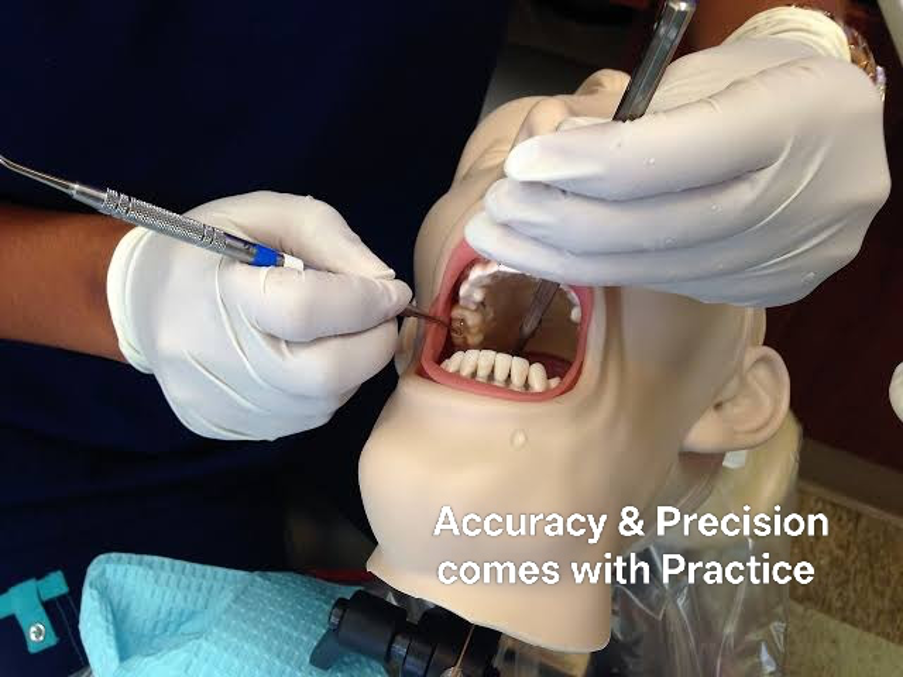
Dental simulations systems have been used in dental education from the mid-eighteenth century and has developed to improve dental students’ transition from the preclinical laboratory to the clinics.
Simulation in dentistry has progressed from the use of oversized models of teeth to simulated patients, virtual reality, haptics and most recently robotics.
The result is a high fidelity experience in a safe learning environment.10
A short survey was conducted to evaluate the students response regarding the use of extracted teeth for preclinical training.
METHODS AND MATERIALS
A short survey was conducted in a premier dental institution in Mumbai, India. The study population consisted of the second year students of the dental institution .A questionnaire of 5 items was constructed. The questions are given in table 1. The questionnaire was then distributed via link "Google form" to all the students with a short explanation of the study and their answering the questionnaire was taken as their consent. The results of the survey are given in table 2.


Free for members
Keep reading — it's free
The rest of this article is open to DentalReach members. Create a free account, or sign in, and every article on the site opens in full.